Saturday, October 17, 2009

On the Slant: International Kindle


Since I ended up reading about academic fairy tale studies on the Wall Street Journal this morning, I also came across this lucid article about the International Kindle:

The Book That Contains All Books: The globally available Kindle could mark as big a shift for reading as the printing press and the codex

I've been an enthusiastic Kindle user since last year when I bought it as merely a convenience for traveling. To not have a supply of books to read at hand is the height of misery for me. I have well over a 1,000 titles on my Kindle now and find I prefer reading with it. And I was a diehard book person previously, a librarian, a woman who has hauled thousands of books back and forth across the country in moves. Books define much of my existence.

Now I find most of my book purchases are for the Kindle, at least my entertainment reading. I prefer reading on my Kindle since I can do it one handed at various print sizes. I read while exercising on my elliptical now. I've even formatted my first three SurLaLune anthologies for the Kindle before anything else since that is how I wanted to read them myself.

Of course, book readers are horrible for illustrated books. The technology is working on that. They are not replacements for books. But they are complements, improving portability, access and ease of use in many ways.

I'm not here to debate Digital Rights Management. All e-readers, including the Kindle, can support books not sold by their distributors. Most of the books on mine were accessed for free and added at no cost to me by me. They are out-of-copyright titles, of course, but I read and study classics. Those can also be shared with other device owners. I've also bought many current titles and spared my groaning shelves over the past year.

And I wish this technology had been available when I was a student, lugging books around that I may or may not need around campus! I am curious to see where the trend goes. I rolled my eyes at the technology a few years ago and now I'm converted. No, it's not the same sensual experience as holding a book. I've heard that complaint over and over again. But when I'm reading novels and unillustrated books, that doesn't matter.

With my reader, I get a book that is lightweight no matter the page length, one that isn't yellowing or giving me allergy issues, one that has the exact same text as the printed version. Reading for me is strictly about the words in about 90% of the materials I read. I find myself picking books to read on the Kindle before the ones laying on the TBR stack next to my bed. Overall, I prefer the reading experience. And I'm not even into reading glasses yet, but choosing a slightly larger text size is wonderful, too. My grandmother suffered from macular degeneration. Her family was always seeking large print books for her, limited to heavy, often irrelevant titles for her. If I am someday afflicted with the same condition, I am thrilled to think virtually no book will be unavailable to me.

In WSJ: Academic Studies of Fairy Tales


Today, the Wall Street Journal offers us:

Academic Studies of Fairy Tales: Holly Tucker selects revelatory studies of fairy tales

I've only seen the online version of the article and it appears rather arbitrary without any explanation beyond the title. Why was this included in today's issue?

Anyway, the article consists of five books which each receive a paragraph length's explanation of their content. A fine list offered by Holly Tucker, herself the author of Pregnant Fictions: Childbirth and the Fairy Tale in Early Modern France (pictured above) and the head editor/inspiration for Wonders and Marvels website which I have been saving for an "on the slant" post. She also teaches a class on fairy tales at Vanderbilt in my hometown.

If you want to read Tucker's recommendations, please click through to the article. I'm posting the titles here with Amazon links since I believe WSJ articles tend to not be free after a period of time and I want to at least let the titles remain public. It's a mix of titles by some of the field's heaviest hitters (Zipes, Tatar and Bottigheimer) as well as the ubiquitious Bettelheim.


1. The Uses of Enchantment by Bruno Bettelheim (Can you believe this is out of print? I guess there are enough used copies floating around to fufill the curiosty for this somewhat debunked but influential book.)


2. Off With Their Heads! by Maria Tatar

3. Grimms' Bad Girls and Bold Boys by Ruth B. Bottigheimer

4. Fairy Tales and the Art of Subversion by Jack Zipes

5. Red Riding Hood for All Ages by Sandra L. Beckett

This Beckett title is confusing and has been on my list to investigate further. Published last year, I believe it is an updated version of Beckett's earlier Recycling Red Riding Hood, but Amazon has a new version of that title listed for this year, too. So perhaps not. The Wonders and Marvels site actually calls the book Recycling Red Riding Hood to confuse the issue more although the cover image doesn't correlate. I'll clear up the confusion when I learn more.

Either way, here's Wayne State Press's description for Red Riding for All Ages:

Red Riding Hood for All Ages investigates the modern recasting of one of the world’s most beloved and frequently told tales. Author Sandra L. Beckett examines an international selection of contemporary fiction for children, adolescents, and adults to find a wide range of narrative and interpretive perspectives in the tale and its revisions. Beckett shows how authors and illustrators from around the globe have renewed the age-old tale in a range of multilayered, sophisticated, and complex textual and visual Red Riding Hood narratives.

With a child protagonist who confronts grown-up issues of sexuality, violence, and death, the Red Riding Hood story appeals to readers of all age groups and is often presented in crossover texts that can be enjoyed by both children and adults. Beckett presents a wide selection of retellings, many of which have been never translated into English. Texts come from a variety of countries in Europe, North America, South America, Africa, and Asia and date from the early twentieth to the twenty-first century. This wealth of stories and illustrations is organized thematically into sections that consider Little Red Riding Hood alternately as a cautionary tale, an initiation story, a story focused on the wolf, a tale inspired by the wolf within, and a story of an unconventional girl who runs with wolves.

This volume provides a global survey of Red Riding Hood’s story in contemporary culture, proving that the character is omnipresent in modern literature and that the universal appeal of her story knows no age boundaries. Red Riding Hood for All Ages will be of interest to scholars of folklore, gender studies, and literature, as well as librarians, educators, parents, and all those interested in the many interpretations of the Red Riding Hood tale.

Sounds like a great book (or both are), especially for Red Riding Hood studies.

In contrast, here's a review for Recycling Red Riding Hood originally published in Marvels and Tales.

Friday, October 16, 2009

The Guardian: 'Animals'


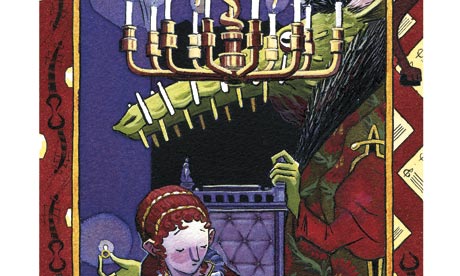
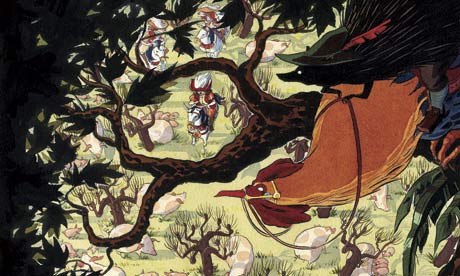
Today's fairy tale booklet (Day 7 and the last one!) at The Guardian is themed 'Animals'. You can read more about the seven part series at my previous post.

Animals in fairytales: Marina Warner looks at the role animals play in fairytales. Warner is the author of From the Beast to the Blonde: On Fairy Tales and Their Tellers, an excellent book I can't recommend highly enough.

Here's an excerpt:

The anthropologist Claude Lévi-Strauss commented that animals were "bons à penser" (good to think with), and fairytales speak through beasts to explore common experiences – fear of sexual intimacy, terror and violence and injustice, struggles for survival. A tradition of articulate, anthropomorphised creatures of every kind is as old as literature itself: animal fables and beast fairytales are found in ancient Egypt and Greece and India, and the legendary Aesop of the classics has his storytelling counterparts all over the world, who use crows and ants, lions and monkeys, ravens and donkeys to satirise the follies and vices of human beings and display along the way the effervescent cunning and high spirits of the fairytale genre.

Today's theme also gives us another three fairy tales to read:

The fairytale of Beauty and the Beast by Jeanne-Marie Le Prince de Beaumont

The fairytale of the Heart of a Monkey retold by Andrew Lang

The fairytale of Hans My Hedgehog by the Brothers Grimm, translated by Jack Zipes

The illustrations for this set are by Eleanor Davis.

There is also an extra article on the site today:

Get off of my tuffet, Muffet by John Harris: I can't lament the demise of nursery rhymes when my three-year-old sings rock'n'roll classics instead

Last week, a survey by the reading charity Booktrust decisively revealed the tragic fate of our old friend the nursery rhyme. Of 2,500 parents, only 36% regularly used such folk poetry with their kids, and over 20% said they never bothered at all. Among younger parents, things were even worse: 33% of mums and dads aged between 16 and 24 reckoned nursery rhymes were "too old-fashioned" to interest their offspring,and 20% of the same cohort questioned their educational value. Somewhat predictably, there was also a gender fault-line within the research: whereas, for example, 78% of women knew all the words to Incy Wincy Spider, the figure among men was a miserable 45%.

And don't miss the reader comments on the last one! Many opinions there...

Andersen's Fairy Park

People's Daily Online posted this shortly before I retired for the evening:

World's first Andersen's fairy park will be built in Shanghai

"Andersen's Fairy Park", the world's first large-scale children's outdoor theme park, will be built in Shanghai before the opening of the Expo 2010 Shanghai.

According to investors, covering an area of more than 80,000 square meters, the park is expected to open in May, 2010.

"Andersen's Fairy Park" will lead the children into the world of fairy tale. A science museum, with theme of Andersen's fairy tales, is planned to be built to popularize humanity and natural science knowledge.

That is all the information I could find so far. It's on several sites so this must be directly from the press release. Thus my quoting of the entire article....

This is also where the Little Mermaid statue from Copenhagen is going to be loaned, at least to the expo.

October 2009: Fairy Tales on Stage


Time for some more recent and/or upcoming theatrical interpretations of fairy tales:

The Nightingale And Other Short Fables: Robert Lepage makes water music

How about this for starters: the action of the second act (The Nightingale) takes place in the orchestra pit, which has been flooded with 67 tonnes of water. You won’t, though, see bass fiddles doubling as lifeboats or violins as paddles – the orchestra and chorus will be onstage.

In the pit’s waist-deep pool, singers will manipulate puppets to tell Hans Christian Andersen’s fairy tale about a nightingale that stops Death from claiming the Chinese emperor.

Cinderella in spikes NEYT throws a screwball at a familiar fairy tale

NEYT presents "Cinderella at the Ballgame," a wildly comic story featuring princesses, fairy godmothers and godfathers, as well as the Boys of Summer, Mel Allen, Bleacher Bums and even the Green Monster.

Driving Cinderella with artistic license: Director Todd Robinson puts '50s spin on classic tale in opera adaptation

What do early 19th-century Italian classical music, a childhood fairy tale, over-the-top humor and references to 1950s-era America have in common? In short, Gioacchino Rossini's classic opera, "La Cenerentola" (Cinderella), as revised and performed by Opera Coeur d'Alene.

MVC Theatre presents 'The Robber Bridegroom' October 7-10 in the Eckilson-Mabee Theatre

The Missouri Valley College Department Of Theatre, Music and Dance will present "The Robber Bridegroom," a musical by Robert Waldman and Alfred Uhry, at 7:30 p.m. nightly from Oct. 7-10 in the Eckilson-Mabee Theatre on the MVC campus. A rousing, bawdy Southern fairy tale based on a Eudora Welty story, set in eighteenth century Mississippi, "The Robber Bridegroom" is the story of the courting of Rosamund, the only daughter of the richest planter in the country, by Jamie Lockhart, a rascally robber of the woods.

The Three Pigs

The three pigs are trying to make it onto America’s Barnyard Idol, but that big, bad Elvis-loving wolf has stolen their ticket to the big audition! Can they get their ticket back in time? There's lots of music and laughter in this original take on The Three Pigs – tons of fun for everyone!

Piwacket Children's Theatre Opens Season with CINDERBOTTOM

Piwacket Children's Theatre begins their 2009-2010 season with a retelling of the familiar Cinderella story, here called CinderBottom. Like all of their productions, there's a lot of tongue-in-cheek humor that makes it palatable for both children and adults, and there are a number of cute little catchy singalong type tunes interspersed as well.

Thursday, October 15, 2009

Snow White Beer Ad

'Ho White' Beer Ad Incurs Disney's Wrath

A beer advertisement featuring Snow White blowing smoke rings while lying in bed with seven semi-naked dwarves has reportedly left Disney fuming.

I'm not sharing imagery but pictures are available through the link. I swerve away from the tasteless and possible copyright infringements on the blog. This one definitely plays very closely with Disney's imagery for the characters. And you don't mess with Disney copyrights. That is a very dangerous proposition. Generic versions of fairy tales: safe. Disney's fairy tales: Not ever safe.

But this is news, so I share it with you...

The Guardian: 'Justice and Punishment'


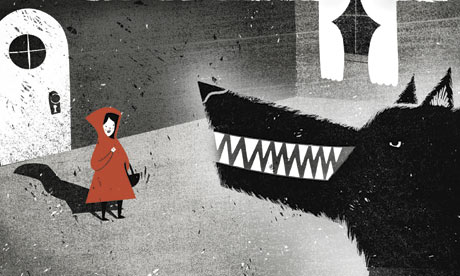
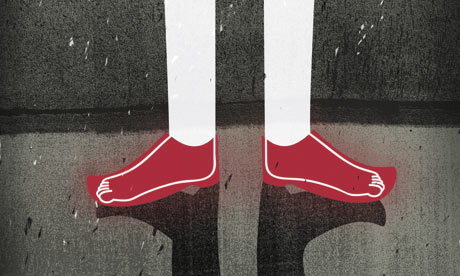
Today's fairy tale booklet (Day 6) at The Guardian is themed 'Justice and Punishment'. You can read more about the seven part series at my previous post.

Justice and punishment in fairytales: Sarah Churchwell looks at the consequences of fairytale sins. Here's an excerpt:

What constitutes transgression changes as much as what constitutes morality. Little Red Riding Hood, in the earliest version, doesn't disobey, she errs, in the most literal sense, wandering away from the path. But in Perrault's tale she isn't warned not to, and so is not punished for heedlessness. She is simply too innocent to know better, and gobbled up by the wolf, without the last-minute rescue by a huntsman to soften the blow for the children listening. The cautionary tale is simple, its lesson clear. The Red Shoes punishes internal transgressions, otherwise known as sins – although Andersen can't tell the difference between venial and mortal sins. But Little Red Riding Hood cautions innocence from the perspective of experience, warning of external dangers. There be wolves. Duly noted.

Today's theme also gives us another four fairy tales to read:

The fairytale of the one-handed murderer by Italo Calvino

The fairytale of Red Riding Hood by Charles Perrault, translated by AE Johnson

The fairytale of the Fisherman and Ifrit from the Arabian Nights, translated by Malcom C Lyons

The fairytale of the Red Shoes by Hans Christian Andersen, translated by Naomi Lewis

The illustrations for this set are by Tyler Garrison.

Related Posts Plugin for WordPress, Blogger...
hostgator discount