Showing posts with label Charles Perrault. Show all posts

Thursday, January 19, 2012

France Month: Les fées by Charles Perrault and illustrated by Charlotte Gastaut


Les fées by Charles Perrault and illustrated by Charlotte Gastaut is today's picture book. I love France Month because we get imagery for tales that are less popular with publishers in English. The Fairies is better known to us as Diamonds and Toads in its many varieties. I couldn't find many images for this book, but I am providing close-ups of the spreads I did find.


Book description:

Il était une fois une veuve qui avait deux filles. L'aînée était le portrait de sa mère pour la méchanceté et la cruauté. Au contraire, la plus jeune des soeurs n'était que douceur, gentillesse et grâce. La mère adorait sa fille aînée et était très dure avec la cadette. Mais une bonne fée, qui passait par là, décida de punir cette injustice...

Tuesday, November 15, 2011

Nursery Rhymes Exhibit in Santa Barbara, California


(This is just here for visual interest, I have no idea what images are in the exhibit itself.)

Nursery Rhymes Exhibit
The Karpeles, Santa BarbaraSanta Barbara, California
September 1 - December 29, 2011

A nursery rhyme is any verse that is customarily and traditionally said or sung to small children. From the point of view of definition, the source and age of the rhyme is immaterial, and it need not originally have been intended for children.

It becomes a nursery rhyme through usage.

Why are Most Nursery Rhymes Old?

When a child has to be entertained, the rhymes and songs most readily recalled are those from an adult's own childhood, and this is the reason why the nursery repertoire is traditional and remains moderately stable. A rare exception is a rhyme or song which was new when the adult was a child may occasionally come to mind along with the old verses, and thus enter the stream of tradition. Two such 'new-commers' are: Twinkle, Twinkle, Little Star (Written by Ann and Jane Taylor in 1806) and Mary Had a Little Lamb (Written by Sarah Josepha Hale in 1830).

The ages of nursery rhymes vary considerably, and the origin and history of each rhyme must be examined individually.


Original Illustrations will be on exhibit from:

Baa, Baa Black Sheep

Cock a Doodle doo

Goosey,goosey,gander

Hickety, pickety

Humpty Dumpty

Jack and Jill

King Arthur

Little Bo Peep

Ring a-round the roses

Simple Simon a

Simple Simon b

There was a crooked man

There Was a Little Man

This Little Piggy

Three wise men of Gotham

Wee Willie Winkie

Oranges and Lemons


In addition, The following will be included in the exhibit:

Charles Perrault
Jack and Jill by L. M. Alcott

This is the House/Jack Built

Sunday, October 23, 2011

Library Essentials Month: Beauties, Beasts and Enchantments: Classic French Fairy Tales edited by Jack Zipes


Beauties, Beasts and Enchantments: Classic French Fairy Tales edited by Jack Zipes is today's library essential. Yes, there seems to be a Beauty and the Beast emphasis this weekend. This is one of the best collections of fairy tales from the French Salon period translated into English. It is the best way to access an English translation of Madame de Villeneuve's entire story of Beauty and the Beast which is actually novella length. Madame Le Prince de Beaumont's derivative of the tale--and the one we are most familiar with--is also in this edition. The small mass market paperback edition, Beauty and the Beast and Other Classic French Fairy Tales, does not have the Villeneuve version. Fortunately, the full version has been reprinted and is much easier to acquire and access.

Zipes's introduction about the salons and the women who dominated them with their fairy tales is also excellent and a great introduction to the topic. Overall, an excellent book and not to be missed if you are interested in the literary history of some of our most popular fairy tales, including those of Charles Perrault which are included in this volume of 36 tales, too.

Description from the publisher:

BEAUTIES, BEASTS AND ENCHANTMENT: CLASSIC FRENCH FAIRY TALES
A new collection of 36 French fairy tales translated by renowned writer and authority on fairy tales, Jack Zipes. Cinderella, Beauty and the Beast, Sleepy Beauty and Little Red Riding Hood are some of the classic fairy tales in this amazing book.

Includes illustrations from fairy tale collections.

'Terrific... a succulent array of 17th and 18th century 'salon' fairy tales'

- The New York Times Book Review

'These tales are adventurous, thrilling in a way fairy tales are meant to be... The translation from the French is modern, happily free of archaic and hyperbolic language... a fine and sophisticated collection'

- New York Tribune

'Enjoyable to read... a unique collection of French regional folklore'

- Library Journal

'Charming stories accompanied by attractive pen-and-ink drawings'

- Chattanooga Times

'An excellent collection'

- Booklist.

Wednesday, November 11, 2009

New Book: The Complete Fairy Tales by Charles Perrault


The Complete Fairy Tales by Charles Perrault, a new translation by Christopher Betts was released last month. As usual, I haven't seen a physical copy to review it, so this is a newsy post.

From the publisher, Oxford University Press:

A pumpkin is transformed into a coach. Bluebeard's young wife unlocks the door of the forbidden room. Children lost in the forest find shelter, but the house belongs to an ogre. These and many other scenes from the stories of Charles Perrault reach deep into the imagination and are never forgotten.

Now, in this scintillating new translation, the fairy tales of Perrault--stories that are known and loved around the world--are available in a beautiful gift edition. This superb translation by Christopher Betts exactly captures the tone and flavor of Perrault's world, and the delightful spirit of the originals. In addition to the classic prose tales--including The Sleeping Beauty in the Wood, Little Red Riding-Hood, Bluebeard, Puss in Boots, Cinderella, and Hop o' my Thumb--this new translation adds Perrault's tales in verse: a long poem on the subject of Patient Griselda; the notorious Donkey-Skin, often expunged from nineteenth-century collections; and the comic Three Silly Wishes.

Bett's introduction deftly illuminates why in Perrault's hands these humble fairly tales have such great imaginative power, showing how they transmute into vivid fantasies the hidden fears and conflicts by which children are affected--fears of abandonment, conflicts with siblings and parents--and resolve so satisfactorily the problems experienced by children during the process of growing up. The volume also includes appendices on related tales and selected variants, a bibliography, chronology, and notes.

With twenty-six stunning illustrations by Gustave Dore, an attractive ribbon marker, and colorful end papers, this wonderful collection of Perrault's fairy tales will make a delightful gift for children of any age.

And here is an excerpt from an excellent and helpful review, A New Translation of Old Fairy Tales by Jenny Williams:

Some of the stories and verses have translated correspondence paired with them. Perrault sent the letters along with a copy of the applicable story to someone he knew. They are very interesting to read, too, and they made me giddy with anticipation to read the stories themselves. With the verse stories, I was surprised to find that I had no trouble reading them and following the plot. Poetry usually puts me off, but not in this case. Some words that I would use to describe Three Silly Wishes, for example, are hilarious, sarcastic, clear, playful and excellent.

The book’s valuable front matter includes an extensive Introduction which goes into Perrault’s life and his writings with plenty of footnotes. Especially fascinating to me was the Notes on the Text and Translation. Here Betts talked about what he changed while translating and what he left alone. He said he believed this “to be the first complete English translation in which verse is rendered in verse.” He placed importance on fidelity to the original tales, while still making the story readable. I think he succeeded. Simple language intended for kids can still have some subtleties that are hard to translate, especially since the meaning of some words has changed over time. So, he consulted 17th century dictionaries. Translating verse is additionally difficult because of maintaining rhyme and meter. Translating is a lot more than just changing words from one language to another. The meaning of the passage has to be considered and also brought across.


I admit that as much as I'm excited about a new translation of Perrault, I'm just as excited by the Dore illustrations. It is very difficult to find the Donkeyskin illustrations since the tale is often omitted from collections, too. I'm hoping all of the illustrations are included. The above collection from Dover has been the most comprehensive to date, but Donkeyskin doesn't appear in it.


To date, The Fairy Tales in Verse and Prose/Les contes en vers et en prose: A Dual-Language Book by Charles Perrault and edited and translated by Stanley Appelbaum has been one of my personal favorites since I like comparing the French to the English when referencing the tales. Of course, there are other excellent translations in other collections, too, including Zipes' Beauties, Beasts and Enchantments, also available in a condensed paperback version. The full version was reprinted earlier this year and I recommend it over the small paperback if you want the full Beauty and the Beast by Villeneuve.

So I will add this one to my extensive reference library sometime soon.

And I leave you with a Donkeyskin illustration by Dore. And a link to the Charles Perrault page on SurLaLune.

Thursday, October 15, 2009

The Guardian: 'Justice and Punishment'


Today's fairy tale booklet (Day 6) at The Guardian is themed 'Justice and Punishment'. You can read more about the seven part series at my previous post.

Justice and punishment in fairytales: Sarah Churchwell looks at the consequences of fairytale sins. Here's an excerpt:

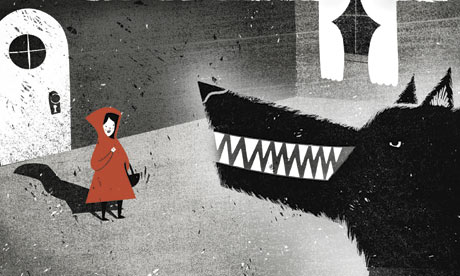
What constitutes transgression changes as much as what constitutes morality. Little Red Riding Hood, in the earliest version, doesn't disobey, she errs, in the most literal sense, wandering away from the path. But in Perrault's tale she isn't warned not to, and so is not punished for heedlessness. She is simply too innocent to know better, and gobbled up by the wolf, without the last-minute rescue by a huntsman to soften the blow for the children listening. The cautionary tale is simple, its lesson clear. The Red Shoes punishes internal transgressions, otherwise known as sins – although Andersen can't tell the difference between venial and mortal sins. But Little Red Riding Hood cautions innocence from the perspective of experience, warning of external dangers. There be wolves. Duly noted.

Today's theme also gives us another four fairy tales to read:

The fairytale of the one-handed murderer by Italo Calvino

The fairytale of Red Riding Hood by Charles Perrault, translated by AE Johnson

The fairytale of the Fisherman and Ifrit from the Arabian Nights, translated by Malcom C Lyons

The fairytale of the Red Shoes by Hans Christian Andersen, translated by Naomi Lewis

The illustrations for this set are by Tyler Garrison.

Related Posts Plugin for WordPress, Blogger...
hostgator discount