Showing posts with label theatre. Show all posts

Friday, January 27, 2012

Scottish Ballet: Sleeping Beauty


This time I have video of a current ballet: The Scottish Ballet's production of Sleeping Beauty. This one is filled with vibrant, bright colors and looks like fun. Too bad I am more than an ocean away... The production is touring Scotland, so it is more accessible if you are there.

This is one of my favorite ballets thanks to the music, I admit. I was raised on Nutcracker (or I raised myself on it and drove the parental units crazy wearing out recordings of it as a preteen) so Tchaikovsky will always be important to me. There's also a gallery on their site of images, but I don't have time to import them here today. It looks like a gorgeous production.

There is also video of a webcast they did backstage of a performance. This is a tech savvy ballet company!


Scottish Ballet: The Sleeping Beauty 2011 - Trailer from Scottish Ballet on Vimeo.

Monday, December 19, 2011

Beauty and the Beast by the Northern Ballet


Northern Ballet has a new ballet production of Beauty and the Beast. I came across some press and foudn the ballet's website where these beautiful images were posted. Lovely. Wish I could see it! The images feature Martha Leebolt as Beauty with Ashley Dixon as the Beast. Photos by Jason Tozer.


From Traditional fairytale becomes ballet with a modern twist:

“I always go back to tales before Disney to find out where the stories come from. There are some wonderful Arabian versions of Beauty and the Beast that are quite dark but have a clear message. One version that inspired me years ago was the Cocteau movie which is wonderful, but that’s more for adults and I wanted to do something different,” says Nixon.

He wanted to give this classic fairytale a contemporary feel. “I was interested in how these ideas could apply to the world today. So the opening sequence looks like Made in Chelsea, or one of those reality TV shows, as well as a bit of a 50s look. It’s about how you look and being cool and yet into that I bring these fairies and sprites and goblins that everyone recognises from the story,” he says. “I wanted to use this idea of retail therapy and haute couture, so you see the girls coming home from their shopping trip with stacks of boxes and giant receipts and this led me to bring into the story this whole idea of debt. The father can’t pay these bills and the debt collectors come in from Gucci and they take the family home away and the family is left on the street.”


Wednesday, August 31, 2011

My Fairytale: Theatre in Solvang, CA


I've previously written about Solvang and the musical, My Fairytale. The play finally had its USA premiere last week in Solvang and the reviews have been positive. There are some successful names behind the production, so that is encouraging. I only wish I still lived in LA so I could drive up and see the play.

About the musical from its press release:

PCPA Theaterfest is proud to present the American Premiere of My Fairytale, a musical about Hans Christian Andersen directed by Scott Schwartz. My Fairytale previews in Santa Maria August 12 - 20, then opens in Solvang’s Festival Theater running from August 26 through September 25, 2011.

The musical is an enchanted journey into the imagination of one of the worlds’ greatest storytellers - it’s a place of wonder, mystery and danger, and where Andersen is confronted by the characters from his fairytales. His quest is to find the Nightingale for the ailing Emperor, but he is continually kept him from his goal, being sidetracked by the fairytale characters, a boy, and a shadow.

My Fairytale was originally produced in Denmark in 2005 in honor of the bi-centennial of Hans Christian Andersen’s birth. Director Scott Schwartz pointed out that this first American production, besides being presented in English for the first time, includes the introduction of puppets, some script rewrites, and additional music by Stephen Schwartz, which will make My Fairytale feel more like a world premiere production. And, it will only be seen at PCPA.

This breathtaking production is filled with a powerful score created by Stephen Schwartz, the award-winning composer of Wicked. The book is by Philip LaZebnik (Pocahontas), and it was originally created by Flemming Enevold, the famous Danish actor and singer.


From My Fairytale at Solvang Festival Theater: U.S. Premiere of Musical Set in the Imagination of Hans Christian Andersen Plays Through September 25 by Charles Donelan:

With the terrific new musical My Fairytale, Solvang enters its second century through the cosmic portal of Hans Christian Andersen’s imagination. PCPA and producer Michael Jackowitz have assembled a brilliant team to design, direct, and perform the vision supplied by Stephen Schwartz (composer) and Philip LaZebnik (author). Beginning with the lifelong conflict that Andersen experienced between his ambition to produce serious works of theater and his propensity to spin out fairy tales with seemingly childish subjects, the show demonstrates that these aims are not merely compatible but complementary.

Andersen, who is wonderfully played and sung by Kevin Cahoon, crashes a reception for the singer Jenny Lind in the opening scene, only to be rebuffed when he indicates that he would like to write a show for Lind and that he intends to audition for the job by putting on a puppet show. Left alone overnight in the Royal Danish National Theater by the snobby board of directors, Andersen anticipates his scheduled morning meeting with the sympathetic Lind by literally diving into his imagination. After a rousing number called “Andersen’s Shadow,” two figures, Andersen and his Shadow (Erik Stein), tumble into the puppet case, only to emerge moments later in a fantasy world that’s entirely constructed out of the figments of Andersen’s overflowing imagination.

Information about tickets, location and dates can be found here.

Wednesday, August 24, 2011

Lisa Stock's Production of Snow, Glass, Apples


If you are in the Atlanta area this weekend, you can see Lisa Stock's production of Snow, Glass, Apples.

From Snow White, snow fright: Lisa Stock's production of Snow, Glass, Apples takes a bite out of the EAV Farmers Market by Jonathan Williams:

With two new live-action versions of the famous fairy tale currently in production, it seems that Snow White has awakened from a proverbial pop culture slumber. But before either of the films hits the big screen, a group of accomplished local thespians is staging a retelling of the familiar story. Snow, Glass, Apples, based on the Neil Gaiman short story of the same name, is a dark take on the tale, portraying Snow White (Carrie Anne Hunt) as a supernatural being and told from the point of view of the stepmother/queen. Produced by Lisa Stock's creative company InByTheEye, Snow, Glass, Apples is Stock's directorial debut in Atlanta after relocating from the Big Apple after 20 years. Stock discusses the play, which runs Aug. 24-28 at the East Atlanta Village Farmers Market.

This is your first production in Atlanta, so let us know a little about your background.

Everything I do is heavily steeped in fairy tales and mythology. I like to put new perspectives on stories we're so familiar with, which is what drew me to Gaiman's story. For me the tales in their earlier forms are really compelling. I like flawed characters a lot and I like to see characters that are making mistakes and not trusting themselves, things I think we can all relate to. Fairy tales are wonderful character studies and the so-called villains are often the most interesting characters and the ones we remember the most.

Before the Brothers Grimm started adding the princes and huntsmen and changing the values, and changing the mother to a stepmother because they couldn't believe that a real mother would be so awful to her child, they had a much harsher and more realistic look on the world. This story is from the stepmother's point of view, which some people might consider the villain or the monster, and I feel like that's just an ages-old tradition of looking at ourselves. When I'm doing Snow, Glass, Apples, I'm sort of focusing on what happens when we don't trust our own instincts.
There's much more in the article, of course. You can click through and read the rest. You can also visit Lisa Stock's website.

Friday, August 5, 2011

Fairy Tale Christmas Pantos in Los Angeles This Christmas

I haven't lived in LA since 2003 and most things I absolutely don't miss, but last year when a Cinderella panto was produced by Lythgoe Family Productions and Magic Pictures International in LA, I was deeply disappointed to not live nearby. The pantos are produced by the Lythgoes in the grand British holiday tradition. Apparently it was successful enough to be brought back this year along with a second production of a Snow White panto, too. Zut!

Anyone wondering what a panto is? Pantos and fairy tales have a long, long history in the theatre. Here's the explanation from the company's website:

WHAT IS A ‘PANTO’? All our shows are written and performed in the genre of ‘PANTO’. Very simply, a panto is family musical theatre that is affordable! The scripts are based on fairytales we all know and love. We like to say that the jokes are written for the adults but the magic is saved for the kids. The 4th wall is broken. We encourage the audience to interact with our actors, ‘Boo the step sisters and cheer for our Prince!’. Comedy is current, sourcing recent news stories and songs are from pop culture that fit in the show, moving the storyline along. It’s a fun treat that brings the whole family together and it only happens once a year, Christmas time.

‘Panto’ is derived from the popular British ‘pantomime’ and serves as many children’s first experience of live theatre.

Here's the official press release. It's too long to block quote so everything below is the release:

Lythgoe Family Productions Announces Two Traditional British Pantos: “A Snow White Christmas” Starring Neil Patrick Harris and Marina Sirtis and “Cinderella Christmas” Starring Fred Willard and Shoshana Bean

LOS ANGELES--(BUSINESS WIRE)--Lythgoe Family Productions and Magic Pictures International announce the 2011 holiday season of traditional British family Panto – the premiere of “A Snow White Christmas,” and the second run of “A Cinderella Christmas.”

Neil Patrick Harris has signed on to star in the onscreen special guest role of "The Magic Mirror" in “Snow White,” following in the tradition of several major stars that have played the role on the London stage; and Marina Sirtis, of Star Trek: The Next Generation fame, will star opposite as The Wicked Queen. The production will be helmed by Bonnie Lythgoe from So You Think You Can Dance AU and choreographed by Dancing With the Stars’ Mark Ballas with American Idol’s Michael Orland serving as Musical Director. An updated version of the classic tale, “Snow White” features family-friendly magic, a comedic twist and modern music, including Lady Gaga’s Born This Way, The Village People’s YMCA, and Michael Jackson’s Thriller. Tickets will be on sale August 9 for “A Snow White Christmas,” running November 30-December 18 at the El Portal Theatre.

“A Cinderella Christmas,” now in its second season following last year’s successful run, will run from December 22 to January 8 at The Scherr Forum Theatre in Thousand Oaks, starring Emmy-nominated comedic actor Fred Willard as Cinderella’s father, Baron HardUp; recording artist and Broadway sensation Shoshana Bean as the fairy godmother, and American Idol's David Hernandez as Dandini.

Both shows will be presented in the style of the traditional British family Panto, a modern musical play based on fairytale stories. A Panto is known for bringing together families with its interactive style and humor that appeals to fairytale fans of all ages.

“Last year’s production of Cinderella exceeded our expectations, and we’re thrilled to continue to bring the family fun of the traditional British Panto to LA audiences with our new production of Snow White,” says Jason Haigh-Ellery, President of Magic Theatre. “Both shows promise to be fun family productions - the perfect holiday present.”

Magic Pictures will hold open auditions for the roles of the “7 Dwarfs” on September 30 and October 1 at Westfield Culver City, where last year a panel of celebrity judges including Mark Ballas, Neil Patrick Harris, Kara Dioguardi, and Mary Murphy, picked the star of “Cinderella” from over 700 performers. A celebrity panel will again be on hand to help choose the standout child actors to star in the seven roles. Leading up to the auditions, Snow White memorabilia will be displayed at the Center, and kids will have the chance to meet Snow White.

Parenting magazine will present the “Snow White Christmas” grand opening celebrity fundraiser Gala on November 29, including a VIP reception, and meet-and-greet with cast members. All proceeds will benefit LA’s BEST After School Enrichment Program. As part of Magic Pictures’ continued community outreach Madame Tussauds, Westfield Culver City, and Bank of America will be donating buses to local schools so that as many kids as possible will have the opportunity to see the shows this holiday season.

For more information and for tickets for the run of shows, please visit www.mpient.com and “like” Lythgoe Family Productions on Facebook.

About Magic Pictures International (MPI)

MPI creates and produces international television formats including "Corkscrewed" and "Who Are You" for Fox, and "Football Superstars" for Fox Sports, recording television sales in over 40 territories. MPI produces theatre in the UK including West End hits “Footloose” and “The Wedding Singer.” Magic Pictures is headed by Kristopher Lythgoe, Becky Baeling and Jason Haigh-Ellery.

About Lythgoe Family Productions

Lythgoe Family Productions produces fun musical theatre the whole family can enjoy. Known for their creativity and involvement in television hits “American Idol” and “So You Think You Can Dance,” the Lythgoes are dedicated to bringing affordable theatre to families across America. Based on the GRIMM Fairytales, each story has been modernized with topical scripts for parents and well known pop songs for kids. The Lythgoes pride themselves on creating a memorable experience a family can share together.


“Snow White Christmas” Opens November 30 at the El Portal Theatre in North Hollywood and “Cinderella Christmas” Opens December 22nd at The Scherr Forum Theatre in Thousand Oaks

Wednesday, July 6, 2011

Theatre: Trumpelstiltskin


From Save the Date: A fairy tale gets Trumped: "Trumpelstiltskin" opens July 7 at Occidental College by Christopher Yee:
Most everyone knows the classic tale of Rumpelstiltskin: An ordinary girl is forced to spin straw into gold, a dwarf shows up to make it happen, and the girl must guess the dwarf’s name or forfeit her first-born child. However, what if that scheming dwarf had the cunning and business acumen of one Donald Trump?

The Occidental College Children’s Theater in Eagle Rock plans to explore that possibility in their next production, “Trumpelstiltskin,” a comedy that debuts on Thursday July 7. The play will run Thursdays through Saturdays at 10 a.m. from July 7 to August 20 at Occidental College’s outdoor Remsen Bird Hillside Theater.


Well, I admit that is one play on the name that I didn't anticipate...

Thursday, June 16, 2011

Theatre: Sleeping Beauty Wakes


From the Sleeping Beauty Wakes website:

McCarter Theatre is proud to announce complete casting and creative team for Sleeping Beauty Wakes, a new musical featuring abook by Rachel Sheinkin (The 25th Annual Putnam County Spelling Bee), and a score by composer Brendan Milburn and lyricist Valerie Vigoda, both of the acclaimed trio GrooveLily. The production, which runs from April 29 through June 5, will be directed by Rebecca Taichman, who delighted McCarter audiences with her 2009 production of Shakespeare’s Twelfth Night. Opening Night is set for Friday, May 6. Following the McCarter run, the production will move to La Jolla Playhouse.

In Sleeping Beauty Wakes, a young beauty is brought to a sleep disorder clinic, and soon all the patients find themselves sharing a familiar dream. The show reunites two members of the acclaimed rock trio GrooveLily – Brendan Milburn and Valerie Vigoda – with Tony Award-winning librettist Rachel Sheinkin, who last collaborated on the inventive holiday tale Striking 12. With beguiling characters, hypnotic lyrics, and a rocking score, Sleeping Beauty Wakes delves into the magical space between dreaming and waking in an unexpected twist on a classic tale.

And a trailer:


And a review from 'Sleeping Beauty Wakes': A Fairy Tale, Updated Without Ambien by CHARLES ISHERWOOD at The New York Times:

Chronic insomniacs may well view the heroine of “Sleeping Beauty Wakes,” a new musical at the McCarter Theater Center here, with a ravenous envy. She’s been dozing peacefully for almost a millennium, without so much as a milligram of pharmaceutical assistance. As in the original fairy tale, tweaked in this modern update, when she emerges from that long slumber she finds herself staring into the eyes of a love-struck swain, not groping for coffee to dispel the dim haze of an Ambien hangover.

Nevertheless, happily ever after does not come without a few major hurdles for Rose (Aspen Vincent), who finds herself bewildered upon waking in the sleep-disorder clinic where this inventive and good-natured but innocuous musical is set. Having been supine for about 900 years, Rose isn’t particularly ambulatory, and the confusions of her new world leave her gaping.

“I don’t understand half the words you say,” she mournfully tells the doctor who’s performing basic tests with exotic objects called a flashlight and a stethoscope. Instead of a polished prince, her savior is a hospital orderly, Mike (Bryce Ryness), with some challenging afflictions of his own, namely a neuropathological combo plate of narcolepsy and cataplexy that has him tumbling to the floor unconscious whenever he feels a surge of happiness. (Go to the NYT site to read the full review.)

Monday, May 23, 2011

Ardiane and Barbe Bleue or, The Useless Deliverance by Maurice Maeterlinck


Bluebeard Tales From Around the World


Ardiane and Barbe Bleue or, The Useless Deliverance by Maurice Maeterlinck is the last of six plays offered in Bluebeard Tales From Around the World. The heroine's name varies from Ariane to Ariadne to Anne to Adriane which was used in the translation from the French by Bernard Miall that appears in the book. The play is very different from anything else in the collection and thus fascinated me as I read and reread it during editing. The play was adapted into the opera Ariane et Barbe-bleue (Ariadne and Bluebeard) by Paul Dukas.

First, here's a short bio about Maeterlinck from the Nobel Prize site since he won the medal in 1911:

Maurice Maeterlinck (1862-1949), born in Ghent, Belgium, came from a well-to-do family. He was educated at a Jesuit college and read law, but a short practice as a lawyer in his home town convinced him that he was unfit for the profession. He was drawn toward literature during a stay in Paris, where he associated with a number of men of letters, in particular Villiers de l'Isle Adam, who greatly influenced him. Maeterlinck established himself in Paris in 1896 but later lived at Saint-Wandrille, an old Norman abbey that he had restored. He was predominantly a writer of lyrical dramas, but his first work was a collection of poems entitled Serres chaudes [Ardent Talons]. It appeared in 1889, the same year in which his first play, La Princesse Maleine, received enthusiastic praise from Octave Mirbeau, the literary critic of Le Figaro, and made him famous overnight. Lack of action, fatalism, mysticism, and the constant presence of death characterize the works of Maeterlinck's early period, such as L'Intruse (1890) [The Intruder], Les Aveugles (1890) [The Blind], and the love dramas Pelléas et Mélisande (1892), Alladine et Palomides (1894), and Aglavaine et Sélysette (1896). The shadow of death looms even larger in his later plays, Joyzelle (1903) and Marie Magdeleine (1909), Maeterlinck's version of a Paul Heyse play, while L'Oiseau bleu (1909) [The Blue Bird] is marked by a fairy-tale optimism. Le Bourgmestre de Stilemonde (1919) [The Burgomaster of Stilemonde] was written under the impact of the First World War.

Maeterlinck developed his strongly mystical ideas in a number of prose works, among them Le Trésor des Humbles (1896) [The Treasure of the Humble], La Sagesse et la destinée (1898) [Wisdom and Destiny], and Le Temple enseveli (1902) [The Buried Temple]. His most popular work was perhaps La Vie des abeilles (1900) [The Life of the Bee], which was followed by L'Intelligence des Fleurs (1907) [The Intelligence of the Flowers], studies of termites (1927), and of ants (1930). In later life, Maeterlinck became known chiefly for his philosophical essays. In 1932 he was given the title of Count of Belgium.

From Nobel Lectures, Literature 1901-1967, Editor Horst Frenz, Elsevier Publishing Company, Amsterdam, 1969
Maeterlinck later tainted his career with an act of academic plagiarism which can be read about on Wikipedia.

His play of Ardiane and Barbe Bleue or, The Useless Deliverance is fascinating and definitely anticipates the 20th century trends and sensibilities. You can read a synopsis of the operatic adaptation (which changed almost nothing from Maeterlinck's original) at Wikipedia.

It's hard to talk about the play without revealing its twisty ending, so SPOILERS here. Ardiane ends up trying to rescue the wives, who are not dead, only imprisoned, as well as Bluebeard. Ultimately, they refuse to be helped, to change their circumstances, to move forward. They stay behind with the wounded Bluebeard. Ardiane departs, free herself, but defeated in her efforts.

Yes, there is all kinds of analysis and symbolism here--Maeterlinck is considered a pioneer of the Symbolist movement. It makes for a great paper and comparison to the other tales in Bluebeard's history.
Here is a short piece on the play from The Academy, Volume 61 (I'm not going to blockquote it):

As to Ariane et Barbe Bleu, M. Maeterlinck warns us against taking them too seriously. They do not claim to convey deep moral or philosophic ideas, but are of the nature of little texts begged from him by musicians as subjects for lyric embroidery. According to Mr. Miall, they are actually being set to music by a M. Gilkas. They are, in fact, slight enough, and although they are marked by many of the familiar features of M. Maeterlinck's manner, the symbolism is simple and less clouded than usual. They require a somewhat spectacular setting, such as an exceptionally poetic opera-comique might perhaps afford. In one there are showers of jewels—emeralds, amethysts, sapphires, pearls, rubies, and diamonds—over the stage; in the other a sudden magical and luminous efflorescence of divine flowers. The more charming of the two—in its unpretending way—is Ariane et Barbe Bleu. The basis of the plot is, of course, our childhood's ancient fairy-tale of Blue-Beard. But Ariane does not go the way of her predecessors. She is the modern woman, ardent for light and knowledge. She goes to set her sisters free, and they will not be set free. The play, by the way, has as subtitle, La Delivrance Inutile. She enters the castle, with the deliberate purpose of disobedience:

Before all things we must disobey. That is the primal duty, when an order comes with threats and is unexplained. The others were wrong, and if they were lost, it was because they hesitated.

She is an indomitable and baffled spirit. Passing the jewels by, she goes straight to the forbidden door and penetrates to the hidden caverns beneath. There she finds all her sisters, all the dear, sad, loving women of the earlier plays, Selysette and Melisande, Ygraine and Bellangere and Alladine. She embraces them, and bids them take heart.

Can you not laugh yet—laugh and clap your hands?
And all the rest are silent! What is this?
What are you? Will you live in terror thus
Always? I do not see you smile at all,
While with your eyes—incredulous eyes !—you watch
My every gesture. Will you not believe
The joyful news? O do you not regret
The light of day, the birds among the boughs,
The high green gardens blowing overhead?
Do you not know the world is in the Spring?
I yester-morning, wandering by the way,
Drank in the light, the sense of space of dawn,
So many flowers beneath my every step,
I knew not where to set my careless feet
Have you forgot the sunlight and the dew,
Dew in the leaves, and laughter of the sea?
The sea but now was laughing as it laughs
On days whereon it knows the wind of joy,
And all its thousand ripples approved my feet,
Its ripples singing on the sands of light ....

She puts herself at their head, teaches them to break out of their dungeon, herself bursts the bars and lets the light, the divine light which they had falsely taken for a superincumbent ocean, flood in. She decks and adorns them, hangs the jewels upon them, frees them even from the constraint of their raiment, bares Selysette's arms and lets the marvel of Melisande's hair flow loose. Her passion and audacity master them for a while. They are on the point of leaving the castle, and then they fail her. The peasants, angered at Barbe Bleue's wickedness, have attacked him. He is brought in wounded, and the women cluster round with soft hearts and tears of pity. Ariane is herself the first to cut his bonds. But her purpose has not changed. Can they be brought to leave him?

Selysette (running after her, and stopping her.)
Ariane, Ariane
Where are you going?

Ariane.
Far away from here.
Down yonder, where I am awaited still. . . .
Do you come with me, Selysette?

Selysette.
I too?
But when will you return?

Ariane.
I shall not.

Melisande.
O!
Ariane!

Ariane.
Are you coming, Melisande?
(Melisande looks to and fro, from Ariane to Barbe Bleue, and does not reply.)
O see the open door, the far blue hills!
Ygraine, are you not coming?
[Yraine does not turn her head.]
Now the moon,
The stars, illumine every road. And you,
Bellangere, do you come?

Bellangere (shortly.)
No. . . .

Sunday, May 22, 2011

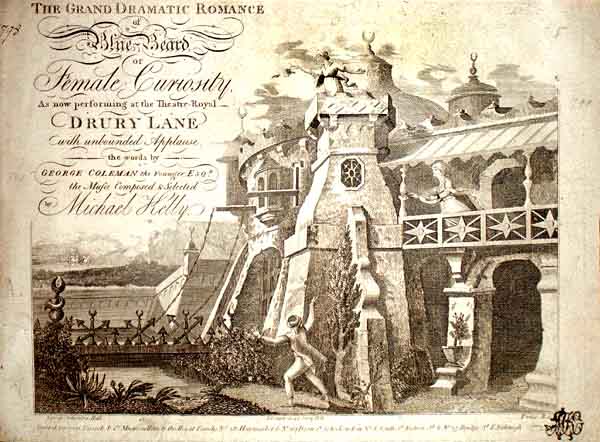
Bluebeard by George Colman the Younger


We often accuse Hollywood of being uncreative and unimaginative, constantly recycling popular films with sequels or remakes. It's a valid accusation but not a new one. It's been a trend with those who produce theatre and entertainment (books included) for centuries. Bluebeard provides a great example of this.

Bluebeard Tales From Around the World

When I started out making editorial decisions for Bluebeard Tales From Around the World I had no intention of including plays in the mix. Then I started reading them and reading about them and I knew I had to include some for they play an important role in Bluebeard's history. One could easily argue that the many, many productions of Bluebeard stories on the stage maintained its visibility and popularity in the 1800s. One of the most important and influential is Bluebeard by George Colman the Younger. From my introduction:

George Colman the Younger’s Blue-beard; or, Female Curiosity! A Dramatick Romance (1798) is often credited with popularizing the portrayal of Bluebeard as a Turk in future literature and illustrations. It didn’t create the trend but built upon the Turkish elements in a French production, Raoul Barbe Bleue (1789) by André Modeste Grétry and Paul Sedaine as well as the growing popularity of the Arabian Nights during that era. Colman’s play served as inspiration to many burlesques and operettas that followed in the 1800s, a few of which are included here.
There were many reasons for giving the production a Turkish setting--too many to discuss here or in my introduction--but it proved an unforgettable choice. The play was a smash hit and cemented the perception of Bluebeard as a Turk--turban, scimitar, and all. I'm oversimplifying the play's influences for the sake of brevity, but there were countless productions of Colman's play--musical actually--as well as remakes and rewrites and spoofs and references throughout the 19th century. Just as Disney influences what we see today about the fairy tales it has produced, Colman's Bluebeard influenced several generations and their perception of Bluebeard to the point where Perrault's popular tale was not as well known as this play by the less literate. There was clever writing and fun songs and a thrilling story.

Bluebeard: A Reader's Guide to the English Tradition

To read more about the work as well as what it influenced, I highly recommend Bluebeard: A Reader's Guide to the English Tradition by Casie E. Hermansson. (It's about much more than that, so I recommend it all around.) And of course, I included the full text of several of the plays in Bluebeard Tales From Around the World.

You can hear piano only renditions of the music from the play at Romantic-Era Songs and even over two centuries later one can understand how this musical caught the public's attention. Never underestimate the power of some catchy tunes. The score was by Michael Kelly.


And here is a very short excerpt from the play, a piece that is often collected in poetry anthologies that was extracted from the play:

Bluebeard
by George Colman the Younger
(1762–1836)

A FOND husband will, after a conjugal strife,
Kiss, forgive, weep, and fall on the neck of his wife.
But Abomelique’s wife other conduct may dread;
When he falls on her neck, ’tis to cut off her head.

How many there are, when a wife plays the fool,
Will argue the point with her calmly and cool;
The bashaw, who don’t relish debates of this sort,
Cuts the woman as well as the argument short.

But whatever her errors, ’tis mighty unfair
To cut off her head just as if ’twere all hair;
For this truth is maintained by philosophers still,
That the hair grows again but the head never will.

And among all the basest, sure he is most base
Who can view, then demolish, a woman’s sweet face!
Her smiles might the malice of devils disarm:
And the devil take him who would offer her harm!

Saturday, February 19, 2011

Robber Bridegroom Musical


From New musical 'steals' the stage 'The Robber Bridegroom' overcomes production woes by Mary Kate Martin:
"The Robber Bridegroom" tells the story of Jamie Lockhart, a man who has two sides: one as an ordinary person and the other as the "Bandit of the Woods." Jamie rescues a rich farmer, Clement Musgrove, and, to thank him for rescuing him, Musgrove offers Jamie marriage to his daughter Rosamund.
Rosamund eventually stumbles upon the Bandit of the Woods, and they soon fall in love, not knowing who the other truly is.

Throw in Salome, Clement Musgrove's scheming second wife, and two villainous bandits, and chaos ensues.

This is the first department musical in 18 years and director Peter Reader said he "wanted to do something based on a book." "The Robber Bridegroom" is based on a novel by Eudora Welty, which is, in turn, loosely based on the Grimm fairy tale of the same name.
I would love to see this one! I love Welty, but alas I don't live near New Jersey to see this one.

The Robber Bridegroom

Saturday, February 12, 2011

Ballet: Cinderella Goes to War


Now this is one I would love to see. But I don't live anywhere near this performance. If you are in the UK, however, you should look this one up if it interests you since it is potentially touring to several locations.  This is a new production of Cinderella from choreographer and director Matthew Bourne.

From Cinderella goes to war by Diane Parkes:

Set during the London Blitz, poor old Cinderella is as busy dodging the German Luftwaffe as she is dealing with the ugly sisters.

But Matthew hopes the essence of the children’s classic comes through his dance.

“I started with the basic story of Cinderella that people already know. I want them to follow the train of events of the fairy tale but also give it a certain complexity. It is fantasy and fairy tale.

“The essential elements are there. The missing shoe, the idea of being lost and then found. I worked in the step mother and the ugly sisters although I went for a larger family to ensure there were enough roles for my dancers.

“There is the element of a kind of prince and of a fairy godmother although mine is a guardian angel. All the elements which give this story its character are there but in a different way.”

In this story Cinderella’s prince is a handsome RAF pilot and, although the two become separated at midnight, the heroine does not disappear in a pumpkin – but in an explosion from a German bomb.

Matthew was very keen that the Second World War be more than just a backdrop to the story, it also generates much of the tale.

“I really love the Prokofiev music to Cinderella because it has such an edge to it and, when I was doing my research into the music, I realised that he wrote it during the Second World War. That made me wonder if that was what gave it its darkness.”

The more Matthew delved into the idea of setting the piece during that conflict, the more it seemed to fit.

“That was a period when there was a real urgency and a need to escape,” he says. “Ideas of time being limited and the risk of losing someone were very much war time themes.
Also, from the Birmingham Hippodrome site where the ballet is being performed.

New Adventures' new production of CINDERELLA is a thrilling and evocative journey through London during the Second World War. Matthew Bourne's interpretation of Prokofiev's haunting score has, at its heart, a true wartime romance. A chance meeting results in a magical night for Cinderella and her dashing young RAF pilot, together just long enough to fall in love before being parted by the horrors of the Blitz.

First seen in the West End in 1997, but now completely revised in this brand new production created to commemorate the 70th anniversary of the Blitz. It features design by Lez Brotherston who won an Olivier award for his original designs, and new lighting designs by Neil Austin. The production will also feature sensational sound design by Paul Groothius which will take the audience into the heart of Prokofiev's magnificent score and the sound world of war-torn London.

CINDERELLA is both a tribute and a testament to the spirit of London during a time when every second counted and lives were changed forever. Bourne's vivid storytelling has never been more heart-stopping and touching, creating a unique and unforgettable depiction of a familiar and beloved fable.

Sunday, January 23, 2011

Theatre: La Belle et la bete

I haven't been posting many reviews or descriptions of fairy tale theatre productions. Honestly, there are so many that it takes a while to find some that appear to offer unique or unusual takes on the tales which is my primary criteria for posting them. Then there's the time it takes to create the post and this hasn't appeared to be one of the more popular SurLaLune blog themes.  That said, I've found a few recently and wanted to share. 


From a review by Pat Donnelly for La Belle et la bete being performed in Montreal as interpreted by Michel Lemieux, Victor Pilon and Pierre Yves Lemieux at Théâtre du Nouveau Monde:

This La Belle is a dedicated 21st-century visual artist rather than an obedient, aspiring bride.

As in a Diana Gabaldon novel, the love affair between her and La Bête reaches beyond time. A modern woman falls for a 3,000-year-old recluse.

What they have in common is their solitude. La Belle, having recently lost her mother in an accident, specializes in scarred female nudes, which she splashes with red paint. (A very Wajdi Mouawad moment.)

For comic relief, there’s a size-shifting female hologram (a sister who seems more like a mother, played by Violette Chauveau) offering chatty advice.

For mystery, there’s the phantom horse (an escapee from Cavalia?) that floats in to lead La Belle to La Bête, so she can return a rose medallion borrowed for artistic inspiration.

Besides the rose and the horse, other symbols from the traditional story, like the magic gloves appear, within altered contexts. Statues (Peter James, on screen, in multiples) come to life. The castle’s thorny forest grows beyond the proscenium and threatens to engulf the audience, as does the pseudo rain, which falls in a torrent.

Friday, January 21, 2011

Theatre: Wolf Tales and Rumpelstiltskin

From Wisecracking Fairy Tales: Robinson Production Company Puts on "Rumpelstiltskin": This duet of plays features a family-friendly twist on old stories by Rachael Dickson, a school theatre production in Virginia, two plays, including interesting interpretations of Three Little Pigs and Rumpelstiltskin:

“Once Upon a Time… you have to start with that or the union comes after you,” a character cracks at the beginning of Wolf Tales, one of two fairy tale themed plays performed by the Robinson Production Company this weekend. These renditions put a family-friendly, humorous spin on traditional stories.

Wolf Tales retells the story of The Three Little Pigs and Little Red Riding Hood through a skewed lens – complete with mobster-style wolves with New Jersey accents, the three little pigs as fighting sisters, and a grandma with some serious ninja fighting skills. Rumpelstiltskin features a much-expanded cast of characters from the original folk story and a green puppet as the title character, with cartoonish background music and props adding a bit more levity to the script.

Tuesday, January 5, 2010

Theatre: Cinderella Eats Beans and Rice

It's the time of year when theatre is glutted with pantos galore, especially in the UK, many without much distinguishing information for me to share on this blog. I try to highlight unusual interpretations of fairy tales--and grand scale ones--but there are too many productions to cover them all. However this one caught my eye this week so here's one to share.


Hartford Children's Theatre Presents CINDERELLA EATS RICE AND BEANS: A SALSA FAIRY TALE 1/15-31/2010

CINDERELLA EATS RICE AND BEANS: A SALSA FAIRY TALE is a critically acclaimed, bilingual children's musical by the award-winning team of playwright Karen Zacarias and composer Deborah Wicks La Puma. The contemporary, Latin-American musical delightfully turns the classic fairy tale on its head, telling the story from both Cinderella and her stepsisters' perspectives. Cinderella, an exchange student from Puerto Rico, comes to the United States to visit her "stepsister" Rosa. The two girls must work together to cross language barriers and cultural differences in order to come to an understanding at the (basket) ball game. With a Fairy Godfather and other delightful twists to the original story, CINDERELLA EATS RICE AND BEANS teaches a subtle lesson on empathy, sportsmanship and respect in the form of a fresh and lively salsa musical.

You can read more about it here or even get tickets if you are anywhere near Hartford, CT: CINDERELLA EATS RICE AND BEANS A Salsa Fairy Tale.

Thursday, December 3, 2009

Matchgirl Ballet


Next week is Little Match Girl week on SurLaLune, but since this is performed this Friday and Saturday by Columbus Dance Theatre, I am offering a preview:

From Ballet goes step beyond classic seasonal fairy tale by Bill Mayr:

The Little Match Girl centers on a poor girl sent out on the street by her harsh father to sell matches on New Year's Eve.

"She's very cold, so she starts to strike matches," Veach explained. "Each time she strikes a match, she has a vision -- a vision of a warm fire, a vision of a banquet where the food comes to life. She has a vision of her grandmother, who is dead, who takes her away to heaven."

The end of the story, Veach noted, is very sad: "People ignored her, and she dies in the cold. But her grandmother takes her away."

That ending, though, serves as the first act of Veach's ballet.

In the second act -- which "looks very different," he said -- the girl arrives in paradise.

"Costumes and scenery are time-nebulous because there is no time in paradise," he said. "All the people on earth who treated her badly dance for her. And she forgives them."

On Stage in November and December: Part 2

Another post about some of the more interesting theatrical interpretations of fairy tales during the holiday season:

Little Red Riding Hood

Hoit directs the fractured fairy tale “Little Red Riding Hood,” a comedic semi-opera written by Marian Partee and Richardson.

Worley is hysterical as the 13-year-old Red, played as a spoiled modern teen obsessed with her Blackberry. Red’s mother, played by Murphy, shares with her daughter a priceless give-and-take that begins the story.

Keating is very funny as Junior Wolf, a teen wolf who wants to be a vegetarian chef. His father, The Big Bad Wolf, is played by Walker, who gets to sing some funny lyrics about hunting down and eating people.

Red and Junior team up to save all the old retired fairy tale heroes at their retirement home.

Murphy, now playing Red’s grandmother Aurora; McLane as one of the three pigs, Hamlet; Beck as an old and frisky Prince Charming; and Hildebrand as Rapunzel are simply insane and uproarious.

The puns fly throughout and several modern day references are lampooned to great success.

Rapunzarella White (Hackensack's Avellino directs revamped 'Rapunzarella')

Rapunzarella White is a brand new musical tale spun from the familiar threads of Rapunzel, Cinderella, and Snow White, in which they are actually triplets cast off into their own separate stories by a very angry witch. Herschel, an adorable Fairy Tailor, weaves together their sad plights before our favorite fairy tale princesses reunite as sisters, when each finds her true Prince Charming...and true love. "Happily Ever After" may never have seemed so far off, but fear not...as in all fairy tales, happiness and love prevail.

The Princess and the Handmaiden (see Class warfare for the kids and Fairy tale isn't kid-friendly)

Leslie Arden's new musical for children, The Princess and the Handmaiden , takes The Goose Girl , one of the lesser-known fairy tales of the Brothers Grimm, adds a few shakes of The Prince and the Pauper , a pinch of All's Well that Ends Well and, to make its Canadian provenance that much more evident, a soupçon of a plea for universal magic care.

Saturday, November 21, 2009

Rumpelstiltskin by David Sawer

Recently on stage and getting its own post because it stands out from the holiday season of other fare: Rumpelstiltskin, CBSO Centre, Birmingham: The wordless reworking of a classic fairy tale makes its timeless message more alarming than ever reviewed by Anna Picard

In Rumpelstiltskin, Sawer's score is a rich broth of Petrushka-esque carnival music, Depression-era dance music and melancholy doynas, with 13 instruments providing the voices of the silent actors. It's a work that is hard to categorise, neither dance nor opera, but storytelling through music and movement.

With shades of Erich von Stroheim's silent film classic Greed in the lighting designs of Mimi Jordan Sherin, Richard Jones's tart, sharp production has Rumpelstiltskin (Sarah Fahie) as a tiny, gold-toothed vagabond. Crippled by debt and drink, the miller (Chris Harrison-Kerr) is hiding from two bailiffs whose pacing feet set the rhythm of the opening dance for double-bass, bassoon and tuba. Muted trumpet and horn announce the distraint of table, chair, even a cobweb, and, in one fantastical, desperate lie, the miller consigns his daughter (Bryony Perkins) to spin straw into gold for the king (Nicholas Lawson). Imprisoned in the wooden box that is Stewart Laing's set, Perkins weeps to a quartet of violin, viola, cello and harp (the players painted, like the actors, with the monochrome cosmetics of early cinema). Pale pizzicato figures cast a chilly spell as the box slides shut and Rumpelstiltskin sets to work, his fee the first-born child of the girl.

Saturday, November 14, 2009

La Cenerentola: Performer's Perspective

Here's a short piece sitting in my draft pile and I need to move it out, so here it is, as it is.

Thought I'd share one performer's perspective on playing Cinderella...

Found in The appeal of 'La Cenerentola', mezzo-soprano Betany Coffland answer questions about playing Cinderella in the opera for the San Jose Opera.

Q What do you love about this role?

A It's been interesting for me to ask, "Why has this story of this young girl in unfortunate circumstances — why has it resonated for so many cultures, through so many centuries?"

She's a good person, and sometimes a clumsy person. She's audacious at times. She gets distressed and angry, and it all makes her real. I think we're all attracted to the inherent sweetness and genuine goodness of Cinderella. She knows what's important in life.

Q Specifically?

A It's this idea of karma, in a way, that you put good things out there and good things happen in return. And I think this idea resonates with all of us. We want to believe that good behavior is rewarded.

Q Is it a contemporary story? Is it relevant, or just a fairy tale?

A It's both contemporary and age-old. It's like Shakespeare; we do his plays over and over again, because they hold the keys to what we as humans are interested in watching play out in drama.

In the opera, Cinderella's stepsisters and stepfather — they're completely greedy. We all have aspects of that in us, along with the humor and the clumsiness we see in the opera. That's why we keep coming back to opera, because we recognize ourselves. It may be exaggerated, but it's real.

Q How does Cinderella change over the course of the opera?

A She learns to trust herself more. I think that when you live through a big experience and you come out the other side still holding onto those values that you had going into it, that gives you a new sense of confidence and renewal.


I often enjoy performers' interpretations of their roles, learning their thoughts about the role since they have to be the character to entertain us well.

Friday, November 13, 2009

On Stage in November and December: Part 1

Oh, to be in London for the holidays....

Thought I'd share this link to an article listing several theatre productions for the holidays, several with holiday themes. Yes, panto season is upon you UKers and I'm jealous. But there is more than pantos, too.

The 20 must-see Christmas shows that are waiting in the wings.

Other than this there are several productions of Into the Woods, Hansel and Gretel, La Cenerentola and of course The Nutcracker coming around. Surprisingly, a few Bluebeards (one that is ick! so I won't link) which definitely does NOT say holiday celebrations to me.

Tuesday, November 10, 2009

On Stage: New Twist on Bluebeard

Saw this intriguing article about a new interpretation of Bluebeard on stage. My excerpt is but a part of the article as always, so click through to read more.

From Bluebeard’s Dark Bunker Intrigues Young New Wife: London Stage Review by Warwick Thompson:

Josef Fritzl, the Austrian man who imprisoned and raped his daughter in a secret bunker, has entered the world of lyric drama.

Daniel Kramer’s new production of Bartok’s “Duke Bluebeard’s Castle” for English National Opera is specific in its references. This contemporary Bluebeard dresses in a central-European, Tegernsee-style jacket. He keeps his family in a concrete cellar. His psychopathic behavior flips on a coin: He’s brutal one minute, and childishly silly the next.

This is the man who brings home a new young wife called Judith. She begs him to open the seven locked doors that she sees around her and to reveal what lies behind them.

There are pluses and minuses to Kramer’s this-represents- that approach. There’s no doubting the modern relevance of the famous fairytale, or its chilling force.

The review isn't stellar--claims the intensity is missing--but the interpretation is certainly current and even relevant with all of the recent news of women held captive and/or murdered of late.

It's a scary world out there, but fairy tales have always known that even if pop culture thinks they don't.
Related Posts Plugin for WordPress, Blogger...
hostgator discount