Showing posts with label poetry. Show all posts

Saturday, October 29, 2011

Library Essentials Month: The Poets' Grimm: 20th Century Poems from Grimm Fairy Tales


The Poets' Grimm: 20th Century Poems from Grimm Fairy Tales edited by Jeanne Marie Beaumont and Claudia Carlson is the other library essential with a poetry theme today. This is a great collection--unfortunately out of print. I admit I am sentimentally attached to it since the editors used SurLaLune to help recruit and find poetry while they were compiling their manuscript. The result was excellent thanks to the editors' hard work and I was happy to have helped it along just a little.

Book description from the publisher:

Writers and readers have long been inspired by the haunting wisdom and sheer imaginative power to be found in the fairy tales of the immortal Brothers Grimm. The editors have collected more than a hundred poems inspired by Grimm tales and written by our finest living poets. A brilliant and informative anthology, a teachable text.

Jeanne Marie Beaumont first book of poetry, Placebo Effects, was selected by William Matthews for the National Poetry Series in 1997. She teaches at Rutgers University. Claudia Carlson works at Oxford University Press in New York. Her poems have appeared in Heliotrope, Coracle, Space and Time, Fantastic Stories and NYCBigCityLit.comm

From the Introduction:

These poems reveal the complex relationship that exists between contemporary poets and a received body of myth or lore. The Grimm tales are subject to a significant amount of skepticism, of refutation or "talking back," and of fracturing or breaking down. Yet an abiding, if irreverent, affection and appreciation for the tales, an acknowledgment of their continuing pull and metaphoric power also can be discerned. There is a mutual enrichment when poets become tale (re)tellers: the poets keep the stories current and fresh and give them back their original vivacity, rigor, and immediacy, while the stories enable the poets to tap into a vast and resonant source of symbol and cultural history. The tales become again "full of mystery like all living things," released from the confines of the nursery, rescued from ossification or sentimentalization, able again to fill us with wonder, dread, and delight.

Table of Contents (sorry no poets names are listed, but you can see the breadth and length of what is offered):

Introduction Landscape: In the Forest
Voices from the Forest
Afraid to Look Afraid to Look Away
Asleep in the Forest
Gretel
Black Fairy Tale
Further Adventures
The Twelve Dancing Princesses
The Sleeping Kingdom
Briar Rose
Instructions
Hotel Grimm
Lost in the Forest
Fairy Tales
Fairy Tale
The Twelve Dancing Princesses
The Maiden Without Hands
The White Snake
The Sister of the Swans
An Embroidery (I)
Cinderella's Story
The Frog Prince
The Stepmother Arrives
Babe in the Woods
The Robber Bridegroom
What Bugs Bunny Said to Red Riding Hood
The Wolf's Postscript to "Little Red Riding Hood"
Grandmother
Gretel, Lost
Hansel Tells Gretel of the Witch
Gretel, from a sudden clearing
Witch Words
The Witch
The Fisherman's Wife
The Sleeper 1 and 2
The Gift
Sleeping Beauty Has Words
The Bear
Snow White and Rose Red
Rapunzel
Rapunzel Shorn
The Prince
Ashputtel
Straw Into Gold
Her Shadow
Snow White in Exile
Dwarves
Fervor
A Spell for Sleeping
from The Sleeping Beauty
The Glass Coffin
Sleeping Beauty's Dreams
The Frog Prince
Fractured Fairy Tale
The Sleeping Princess
Sleeping Beauty
Beauty Sleeping Now
Jealousy
Fable
Immortality
The Objects in Fairy Tales
Snow White: The Mirror
Snow White Turns 39
The Poisoned Apple
Rampion
Rapunzel's Clock
The Glass Slipper
The Twelve Dancing Princesses
Masquerade
Cinderella's Life at the Castle
Little Red-Cap
Rapunzel
The Skeptical Prince
Rumplestiltskin Keeps Mum
Kissing the Toad
How to Change a Frog Into a Prince
Where's Wolf?
Hans My Hedgehog
Cinderella
The Robber Bridegroom
The Goosegirl
Rapunzel
The Fisherman's Wife
Sex and Politics in Fairyland
Fairy Tale
Rapunzel
Song for Rapunzel
Cinderella Dream at Ten
Cinderella
The Two Gretels
One-Eye, Two-Eyes, Three-Eyes
Brother and Sister
Cinderella
Gretel
Fat Is Not a Fairy Tale
Rose Red
The Stepsister's Story
Girl Without Hands
Rampion
To the Nixie of the Mill-Pond
Little Red Riding Hood
Lessons from a Mirror
The Wicked Witch
Against Cinderella
The Sleeping Beauty: Variation of the Prince
The True Story of Snow White
Anaconda Mining Makes the Seven Dwarfs an Offer
HM Customs & Excise
Juvenile Court
The Social Worker Finds Hansel and Gretel Difficult to Place
On a Nineteenth Century Color Lithograph of Red Riding Hood by the Artist J. H.
The Peasant Girl
The Ugly Stepsister
Grave Fairytale
Rapunzel: A Modern Tale
Scorched Cinderella
The Girl With No Hands
Snow White and the Seven Deadly Sins
Snow White and the Man Sent to Fetch Her Heart
Snow White
Hazel Tells LaVerne
Sleeping Beauty
Achtung, My Princess, Good Night
Ever After
Kissing the Frog
Cinderella
Cinderella and Lazarus, Part II
Twenty Years After
Gretel in Darkness
Hansel's Game
Snow White Over & Over
Snow White: The Prince
From the Journals of the Frog Prince
The Prince Who Woke Briar Rose
Queen Charming Writes Again
Gretel
An Interview with Red Riding Hood, Now No Longer Little
The Archaeology of a Marriage
Two Lines from the Brothers Grimm
The Old Story
Daughters with Toad
Dock
A Fairy Tale
Fundevogel
A Happy Ending for the Lost Children
Nocturne with Witch, Oven and Two Little Figures
Snow White
Conversation with My Father
Transfiguration Begins at Home
Castrato
Poem About Straw
The Wolf in the Bed
The Sleeping Beauty
This Is a Convalescent Home, Not the Fairy Tale Cottage and Always the Good Father
Like Gretel
Reading the Brothers Grimm to Jenny
Kinder-und Hausmarchen
About the Authors
Acknowledgments
Selected Bibliography
Index of Poems by Tale
Index of Authors and Titles
About the Editors

And an old review I wrote for it:

While this collection might appear gimmicky to some, a quick persusal of the table of contents will show that many respected poets have used fairy tale motifs in their work. Beaumont and Carlson have gathered numerous poems from a wide range of poets that reflect the enduring themes and characters we inherited through the work of the Brothers Grimm. The usual suspects, such as Anne Sexton, are here but so are some lesser known poets. The anthology is strong and represents many well-known fairy tales along with a few that are lesser known by the general public. The book is recommended for libraries and classrooms in which poetry and/or fairy tales are taught. It also makes great armchair reading for anyone interested in new interpretations of familiar stories.

Library Essentials Month: Disenchantments: An Anthology of Modern Fairy Tale Poetry by Wolfgang Mieder


Disenchantments: An Anthology of Modern Fairy Tale Poetry edited by Wolfgang Mieder
Disenchantments: An Anthology of Modern Fairy Tale Poetry edited by Wolfgang Mieder is one of two of today's library essentials. Today's theme is poetry if you were wondering. This book is the first collection of fairy tale poetry by various poets published in English to my knowledge. It is a wonderful collection, too, and pretty impressive considering it was compiled before the internet made researching poetry somewhat easier. All of the poetry is thought provoking, but Mieder's introduction is the wonderful resource also. I haven't seen too many articles about poetry and fairy tales like this one and it is a great overview to the genre even 25+ years later.

List of Contents (not in order):

Pantomime Diseases by Dannie Abse
Cinderella by Feroz Ahmed-ud-din
The Princess Addresses The Frog Prince by Elizabeth Brewster
Cinderella by Olga Broumas
Little Red Riding Hood by Olga Broumas
Rapunzel by Olga Broumas
Snow White by Olga Broumas
Dornoschen by Hayden Carruth
Red Riding Hood by Guy Wetmore Carryl
Ripening by Noelle Caskey
Mythics by Helen Chasin
Snow White by Robert M. Chute
The Sleeping Beauty by Leonard Cohen
Rose Red To Snow White by Joan Colby
Dreambooks by Alfred Dewitt Corn
Little Red Riding Hood And The Wolf by Roald Dahl
Snow White And The Seven Dwarfs by Roald Dahl
The Princess In The Ivory Tower by Joy Davidman
The Sleeping Beauty by Walter John De La Mare
The Dolls Play At Hansel And Gretel by William Dickey
Epithalamium by John Ditsky
Coach by Eleanor Farjeon
Cinderella Grass by Aileen Fisher
Fairy Tales by Jane Flanders
The Sleeping Beauty by Sara De Ford
Beauty, Sleeping by Arthur Freeman
Ella Of The Cinders by Mary Blake French
Snow White by Robert Gillespie
Gretel In Darkness by Louise Gluck
The Frog And The Golden Ball by Robert Ranke Graves
Mirror by Donald Hall
Antistrophe by William Hathaway
The Gold Factory by William Hathaway
In Dead Air, Under Furious Sun by William Hathaway
Liar Rumplestiltskin Loves by William Hathaway
Rumplestiltskin's Plan by William Hathaway
The Benefactors by Sara Henderson Hay
Interview by Sara Henderson Hay
Juvenile Court by Sara Henderson Hay
The Marriage by Sara Henderson Hay
The Name by Sara Henderson Hay
One Of The Seven Has Something To Say by Sara Henderson Hay
The Princess by Sara Henderson Hay
Rapunzel by Sara Henderson Hay
The Sleeper by Sara Henderson Hay
Rebels From Fairy Tales by Hyacinthe Hill
And When The Prince Came by Robert Silliman Hillyer
Coup De Grace by Anthony D. Hope
Cinderella Liberated by Anne Hussey
The Sleeping Beauty by Mary Hutton
Cinderella by Randall Jarrell
The Marchen (grimm's Tales) by Randall Jarrell
The Sleeping Beauty: Variation Of The Prince by Randall Jarrell
Sleeping Beauty by Charles Johnson
Becoming A Frog by Paul R. Jones
Tellers Of Tales by Chester Simon Kallman
Kissing The Toad by Galway Kinnell
Sleeping Beauty: August by Douglas Knight
The Archaeology Of A Marriage by Maxine W. Kumin
An Embroidery by Denise Levertov
The Dwarf by Gerald Locklin
Rapunzel by Eli W. Mandel
The Sleeping Beauty by Edward Leslie Mayo
Rapunzel Song by Gerard Previn Meyer
Prince Charming by John R. Miller
Cinderella by Roger Mitchell
From The Journals Of The Frog Prince by Susan Mitchell
The Two Gretels by Robin Morgan
Reading The Brothers Grimm To Jenny by Lisel Mueller
Sleeping Beauty by Howard Nemerov
To A Child by Norreys Jephson O'conor
The Sleeping Beauty by Wilfred Owen
The Gingerbread House by John Ower
The Frog Prince by Robert Pack
Frog Prince by Phoebe Pettingell
Cinderella by Cynthia Pickard
Cinderella by Sylvia Plath
Coach Into Pumpkin by Dorothy E. Reid
Modern Grimm by Dorothy Lee Richardson
Maymie's Story Of Red Riding-hood by James Whitcomb Riley
A Sleeping Beauty by James Whitcomb Riley
Cinderella's Song by Elizabeth Madox Roberts
The Frog Prince by Anne Sexton
Little Red Riding Hood by Anne Sexton
Rapunzel by Anne Sexton
Rumpelstiltskin by Anne Sexton
Snow White And The Seven Dwarfs by Anne Sexton
Sleeping Beauty by Laurie Sheck
Sleeping Beauty by Jane Shore
Red Riding Hood At The Acropolis by Myra Sklarew
The Frog Prince by Florence Margaret Smith
Vancouver Island by Joan Swift
A Fairy Tale by Phyllis Hoge Thompson
Breasts by Barbara Unger
Rapunzel by Louis Untermeyer
A Sleeping Beauty by Evelyn M. Watson
Lost Cinderella by Edith Weaver
Happy Endings by Gail White
Sleeping Beauty by Elinor Wylie
A Fairy Tale by Vitomil Zupan

Wednesday, October 19, 2011

Fathers by Delia Sherman


STONE TELLING is a new literary speculative poetry quarterly dedicated to boundary-crossing and multi-perspective poetry. The current issue was released a few weeks ago and has some offerings of interest to readers here, such as Fathers by Delia Sherman.

In "Fathers," Sherman explores three father characters from fairy tales, The Woodcutter from Hansel and Gretel, The Merchant from Cinderella and The King from Snow White. Excellent reading.

Here's the beginning to whet your appetite:

1. The Woodcutter

He climbs the ladder, rungs creaking underfoot,
Dreary as hunger. At the back of the loft,
Two children cup themselves around a pocket of warmth
Like mice in the hay, chewing on straws for comfort.
Their whispering stops as he approaches,
Kneels, stiff as frost, touches their cold faces
And says—

Delia is great and a discussion of the poem is also available at Roundtable.

Sunday, July 10, 2011

Sabrina Fair the Water Nymph


Sabrina Fair Sabrina - The Centennial Collection Sabrina
One of my favorite classic movies as a teen was Sabrina starring Audrey Hepburn, Humphrey Bogart and William Holden. It's not a perfect movie and even flawed in places, but I adored it all the same. A few years later the movie was remade with Julia Ormond, Harrison Ford and Greg Kinnear and I enjoyed that one, too, despite its flaws. At that point I was in college and was able to learn more about the movie's history thanks to news articles and access to more information although the internet as an information tool was just blossoming. I special ordered a copy of the original play, Sabrina Fair by Samuel Taylor from my university bookstore and was charmed by it, too.

But today we are talking about Sabrina or Sabrina Fair whose name is important to some degree in all three renditions. From the 1995 film:

Linus Larrabee: So, that really is a beautiful name. How did you get it?
Sabrina: My father's reading. It's in a poem.
Linus Larrabee: Oh?
Sabrina: "Sabrina fair, listen where thou art sitting under the glassy, cool, translucent wave, in twisted braids of lilies knitting the loose train of thy amber-dropping hair."

****

Linus Larrabee: [pause] So, your little poem - what does it mean?
Sabrina: It's the story of a water sprite who saved a virgin from a fate worse than death.
Linus Larrabee: And Sabrina's the virgin.
Sabrina: [quietly] Sabrina's the savior.

You can read the similar conversation in the original play here on pages 41-42. In that version, I learned that the poem was from John Milton's play, Comus. You can read an online version of Comus here or read about it on Wikipedia.

Mermaid and Other Water Spirit Tales From Around the World


Sabrina, as a water sprite, is referenced frequently enough in literature beyond the Sabrina play/films that I decided to include the excerpt from Comus in Mermaid and Other Water Spirit Tales From Around the World since her semi-fame was brought about by the play. Alas, these days the name is more often associated with witches thanks to shows like Sabrina the Teenage Witch, but she was a princess and then a water sprite, not a witch in folklore.

Milton didn't invent the character, however. Sabrina—also known as Sabre, Severn, Hafren, Habrena—first appears in Geoffrey of Monmouth's Historia Regum Britanniae (c. 1136). A princess who drowned in the river Severn, she later became a goddess associated with the river.

I'm only going to include the first part of the excerpt since it is rather long overall. Most quotes only use the short Sabrina Fair sequence that appears in the play/films. But I am including the part previous to that which describes Sabrina to the audience.


SPIRIT: There is a gentle Nymph not far from hence,
That with moist curb sways the smooth Severn stream:
Sabrina is her name: a virgin pure;
Whilom she was the daughter of Locrine,
That had the sceptre from his father Brute.
She, guiltless damsel, flying the mad pursuit
Of her enraged stepdame, Guendolen,
Commended her fair innocence to the flood
That stayed her flight with his cross-flowing course.
The water-Nymphs, that in the bottom played,
Held up their pearled wrists, and took her in,
Bearing her straight to aged Nereus’ hall;
Who, piteous of her woes, reared her lank head,
And gave her to his daughters to imbathe
In nectared lavers strewed with asphodil,
And through the porch and inlet of each sense
Dropt in ambrosial oils, till she revived.
And underwent a quick immortal change,
Made Goddess of the river. Still she retains
Her maiden gentleness, and oft at eve
Visits the herds along with twilight meadows,
Helping all urchin blasts, and ill-luck signs
That the shrewd meddling Elf delights to make,
Which she with pretious vialed liquors heals:
For which the Shepherds, at their festivals,
Carol her goodness loud in rustic lays,
And throw sweet garland wreaths into her stream,
Of pansies, pinks, and gaudy daffadils.
And, as the old Swain said, she can unlock
The clasping charm, and thaw the numbing spell,
If she be right invoked in warbled song;
For maidenhood she loves, and will be swift
To aid a virgin, such as was herself,
In hard-besetting need. This will I try,
And add the power of some adjuring verse.

Song for Sabrina

Sabrina fair,
Listen where thou art sitting
Under the glassy, cool, translucent wave,
In twisted braids of lilies knitting
The loose train of thy amber-dropping hair;
Listen for dear honour’s sake,
Goddess of the silver lake,
Listen and save!

Saturday, July 2, 2011

The Lord of Dunkerron


Mermaid and Other Water Spirit Tales From Around the World

Here's a ballad from Mermaid and Other Water Spirit Tales From Around the World for your Saturday...

Illustration by George Wharton Edwards


The Lord of Dunkerron

THE lord of Dunkerron—O’Sullivan More,
Why seeks he at midnight the sea-beaten shore?
His bark lies in haven, his bounds are asleep;
No foes are abroad on the land or the deep.

Yet nightly the lord of Dunkerron is known
On the wild shore to watch and to wander alone;
For a beautiful spirit of ocean, ’tis said,
The lord of Dunkerron would win to his bed.

When, by moonlight, the waters were hush’d to repose,
That beautiful spirit of ocean arose;
Her hair, full of lustre, just floated and fell
O’er her bosom, that heav’d with a billowy swell.

Long, long had he lov’d her—long vainly essay’d
To lure from her dwelling the coy ocean maid;
And long had he wander’d and watch’d by the tide,
To claim the fair spirit O’Sullivan’s bride!

The maiden she gazed on the creature of earth,
Whose voice in her breast to a feeling gave birth;
Then smiled; and, abashed as a maiden might be,
Looking down, gently sank to her home in the sea.

Though gentle that smile, as the moonlight above,
O’Sullivan felt ’twas the dawning of love,
And hope came on hope, spreading over his mind,
Like the eddy of circles her wake left behind.

The lord of Dunkerron he plunged in the waves,
And sought through the fierce rush of waters, their caves;
The gloom of whose depth studded over with spars,
Had the glitter of midnight when lit up by stars.

Who can tell or can fancy the treasures that sleep
Intombed in the wonderful womb of the deep?
The pearls and the gems, as if valueless, thrown
To lie ‘mid the sea-wrack concealed and unknown.

Down, down went the maid,—still the chieftain pursued;
Who flies must be followed ere she can be wooed.
Untempted by treasures, unawed by alarms,
The maiden at length he has clasped in his arms!

They rose from the deep by a smooth-spreading strand,
Whence beauty and verdure stretch’d over the land.
“Twas an isle of enchantment! and lightly the breeze,
With a musical murmur, just crept through the trees.

The haze-woven shroud of that newly born isle,
Softly faded away, from a magical pile,
A palace of crystal, whose bright-beaming sheen
Had the tints of the rainbow—red, yellow, and green.

And grottoes, fantastic in hue and in form,
Were there, as flung up—the wild sport of the storm;
Yet all was so cloudless, so lovely, and calm,
It seemed but a region of sunshine and balm.

“Here, here shall we dwell in a dream of delight,
Where the glories of earth and of ocean unite!
Yet, loved son of earth! I must from thee away;
There are laws which e’en spirits are bound to obey!

“Once more must I visit the chief of my race,
His sanction to gain ere I meet thy embrace.
In a moment I dive to the chambers beneath:
One cause can detain me—one only—’tis death!”

They parted in sorrow, with vows true and fond;
The language of promise had nothing beyond.
His soul all on fire, with anxiety burns:
The moment is gone—but no maiden returns.

What sounds from the deep meet his terrified ear—
What accents of rage and of grief does he hear?
What sees he? what change has come over the flood—
What tinges its green with a jetty of blood?

Can he doubt what the gush of warm blood would explain?
That she sought the consent of her monarch in vain!
For see all around him, in white foam and froth,
The waves of the ocean boil up in their wroth!

The palace of crystal has melted in air,
And the dies of the rainbow no longer are there;
The grottoes with vapour and clouds are o’ercast,
The sunshine is darkness—the vision has past!

Loud, loud was the call of his serfs for their chief;
They sought him with accents of wailing and grief:
He heard, and he struggled—a wave to the shore,
Exhausted and faint, bears O’Sullivan More!

Kenmare, 27th April, 1825.

Source:


Croker, Thomas Crofton. Fairy Legends and Traditions of the South of Ireland. London: John Murray, 1828.

Thursday, June 30, 2011

The Mermaid of Galloway by Allan Cunningham


Mermaid and Other Water Spirit Tales From Around the World The Mermaid Of Galloway

Mermaid and Other Water Spirit Tales From Around the World (still discounted to $31.57) has the full ballad of The Mermaid of Galloway by Allan Cunningham that I mentioned in my earlier Mermaid Music and $2 Off Today Only when I recommended Emily Smith's vesion, The Mermaid Of Galloway. So I thought I would share it here today. Please note that Smith's is modernized somewhat, but that is often a boon to modern listeners.


The Mermaid of Galloway
by Allan Cunningham


THERE’S a maid has sat on the green merse side
These ten lang years and mair;
An’ every first night o’ the new moon
She kames her yellow hair.

An’ ay while she sheds the yellow burning gowd,
Fu’ sweet she sings an’ hie,
Till the fairest bird that wooes the green wood,
Is charm’d wi’ her melodie.

But wha e’er listens to that sweet sang,
Or gangs the dame to see,
Ne’er hears the sang o’ the laverock again,
Nor wakens an earthly ee.

It fell in about the sweet simmer month,
I’ the first come o’ the moon,
That she sat o’ the tap of a sea-weed rock,
A-kaming her silk-locks down.

Her kame was o’ the whitely pearl,
Her hand like new-won milk;
Her breasts were all o’ the snawy curd,
In a net o’ sea-green silk.

She kamed her locks owre her white shoulders,
A fleece baith bonny and lang;
An’ ilka ringlet she shed frae her brows,
She raised a lightsome sang.

I’ the very first lilt o’ that sweet sang,
The birds forsook their young;
An’ they flew i’ the gate o’ the grey howlet,
To listen the sweet maid’s song.

I’ the second lilt o’ that sweet sang,
Of sweetness it wes sae fu’;
The tod leap’d out frae the frighted lambs,
And dighted his red-wat mou’.

I’ the very third lilt o’ that sweet sang,
Red lowed the new-woke moon;
The stars drapped blude on the yellow gowan tap,
Sax miles that maiden roun’.

‘I hae dwalt on the Nith,’ quo’ the young Cowehill,
‘These twenty years an’ three,
But the sweetest sang e’er brake frae a lip,
Comes thro’ the green wood to me.

‘O is it a voice frae twa earthly lips,
Whilk makes sic melodie?
It wad wile the lark frae the morning lift,
And weel may it wile me.’

‘I dreamed a dreary thing, master,
Whilk I am rad ye rede;
I dreamed ye kissed a pair o’ sweet lips,
That drapped o’ red heart’s-blede.’

‘Come, haud my steed, ye little foot-page,
Shod wi’ the red gold roun’;
Till I kiss the lips whilk sing sae sweet,’
An’ lightlie lap he down.

‘Kiss nae the singer’s lips, master,
Kiss nae the singer’s chin;
Touch nae her hand,’ quo’ the little foot-page,
‘If skaithless hame ye ’d win.

‘O wha will sit on yere toom saddle,
O wha will bruik yere gluve;
An’ wha will fauld yere erled bride,
I’ the kindly clasps o’ luve?’

He took aff his hat, a’ gold i’ the rim,
Knot wi’ a siller ban’;
He seemed a’ in lowe wi’ his gold raiment,
As thro’ the green wood he ran.

‘The simmer-dew fa’s saft, fair maid,
Aneath the siller moon;
But eerie is thy seat i’ the rock,
Washed wi’ the white sea faem.

‘Come, wash me wi’ thy lilie white hand,
Below and aboon the knee;
An’ I’ll kame thae links o’ yellow burning gold,
Aboon thy bonnie blue ee.

‘How rosie are thy parting lips,
How lilie-white thy skin,
An’ weel I wat thae kissing een
Wad tempt a saint to sin.’

‘Tak aff thae bars an’ bobs o’ gold,
Wi’ thy gared doublet fine;
An’ thraw me aff thy green mantle,
Leafed wi’ the siller twine.

‘An’ all in courtesie, fair knight,
A maiden’s love to win;
The gold lacing o’ thy green weeds
Wad harm her lilie skin.’

Syne coost he aff his green mantle,
Hemm’d wi’ the red gold roun’;
His costly doublet coost he aff
Wi’ red gold flow’red down.

‘Now ye maun kame my yellow hair,
Down wi’ my pearlie kame;
Then rowe me in thy green mantle,
An’ take me maiden hame.

‘But first come take me ’neath the chin,
An’ syne come kiss my cheek;
An’ spread my hanks o’ wat’ry hair,
I’ the new-moon beam to dreep.’

Sae first he kissed her dimpled chin,
Syne kissed her rosie cheek;
And lang he wooed her willin’ lips,
Like heather-hinnie sweet!

‘O! if ye’ ll come to the bonnie Cowehill,
’Mang primrose banks to woo,
I’ll wash thee ilk day i’ the new-milked milk,
An’ bind wi’ gold yere brow.

‘An’ a’ for a drink o’ the clear water
Ye ’se hae the rosie wine,
An’ a’ for the water white lilie,
Ye ’se hae these arms o’ mine.’

‘But what ’ll she say, yere bonnie young bride
Busked wi’ the siller fine,
Whan the rich kisses ye kept for her lips,
Are left wi’ vows on mine?’

He took his lips frae her red-rose mou’,
His arms frae her waist sae sma’;
‘Sweet maiden, I’m in bridal speed,
It’s time I were awa’.

‘O gie me a token o’ luve, sweet May,
A leal luve-token true;’
She crapped a lock o’ yellow golden hair,
An’ knotted it roun’ his brow.

‘O tie nae it sae strait, sweet May,
But with luve’s rose-knot kind;
My head is full of burning pain,
O saft ye maun it bind.’

His skin turned all o’ the red-rose hue,
Wi’ draps o’ bludie sweat;
An’ he laid his head ’mang the water lilies:
‘Sweet maiden, I maun sleep.’

She tyed ae link of her wet yellow hair,
Aboon his buruing bree;
Amang his curling haffet locks
She knotted knurles three.

She weaved owre his brow the white lilie,
Wi’ witch-knots mae than nine;
‘Gif ye were seven times bridegroom owre,
This night ye shall be mine.’

O twice he turned his sinking head,
An’ twice he lifted his ee;
O twice he sought to loose the links
Were knotted owre his bree.

‘Arise, sweet knight, yere young bride waits,
An’ doubts her ale will sour;
An’ wistly looks at the lilie-white sheets,
Down spread in ladie bower.

‘An’ she has preened the broidered silk,
About her white hause-bane;
Her princely petticoat is on,
Wi’ gold can stan’ its lane.’

He faintlie, slowlie, turn’d his cheek,
And faintly lift his ee,
And he strave to loose the witching bands
Aboon his burning bree.

Then took she up his green mantle
Of lowing gold the hem;
Then took she up his silken cap,
Rich wi’ a siller stem;
An’ she threw them wi’ her lilie hand
Amang the white sea faem.

She took the bride ring frae his finger
An’ threw it in the sea;
‘That hand shall mense nae ither ring
But wi’ the will o’ me.’

She faulded him i’ her lilie arms,
An’ took her pearlie kame;
His fleecy locks trailed owre the sand
As she sought the white sea-faem.

First rose the star out owre the hill,
An’ neist the lovely moon;
While the beauteous bride o’ Galloway
Looked for her blythe bridegroom.

Lightlie she sang while the new moon rose,
Blythe as a young bride May,
Whan the New Moon lights her lamp o’ luve,
An’ blinks the bride away.

‘Nithsdale, thou art a gay garden,
Wi’ monie a winsome flower;
But the princeliest rose o’ that garden
Maun blossom in my bower.

‘O gentle be the wind on thy leaf,
And gentle the gloaming dew;
And bonnie and balmy be thy bud,
Of a pure and steadfast hue;
And she who sings this sang in thy praise,
Shall love thee leal and true.’

An’ ay she sewed her silken snood,
An’ sung a bridal sang;
But oft the tears drapt frae her ee,
Afore the grey morn cam’.

The sun leamed ruddie ’mang the dew,
Sae thick on bank and tree;
The plough-boy whistled at his darg,
The milk-may answered hie;
But the lovely bride o’ Galloway
Sat wi’ a tear-wet ee.

Ilk breath o’ wind ’mang the forest leaves—
She heard the bridegroom’s tongue,
And she heard the bridal-coming lilt
In every bird which sung.

She sat high on the tap tower stane,
Nae waiting May was there;
She loosed the gold busk frae her breast,
The kame frae ’mang her hair;
She wiped the tear-blobs frae her ee,
An’ looked lang and sair.

First sang to her the blythe wee bird,
Frae aff the hawthorn green:
‘Loose out the love curls frae yere hair,
Ye plaited sae weel yestreen.’

An’ the spreckled lark frae ’mang the clouds
Of heaven came singing down:
‘Take out the bride-knots frae yere hair
An’ let these lang locks down.’

‘Come, bide wi’ me, ye pair o’ sweet birds,
Come down and bide wi’ me;
Ye sall peckle o’ the bread an’ drink o’ the wine,
And gold yere cage sall be.’

She laid the bride-cake ’neath her head,
An’ syne below her feet;
An’ laid her down ’tween the lilie-white sheets,
An’ soundlie did she sleep!

It seemed i’ the mid-hour o’ the night,
Her siller-bell did ring;
An’ soun’t as if nae earthlie hand
Had pou’d the silken string.

There was a cheek touch’d that ladie’s,
Cauld as the marble stane;
An’ a hand cauld as the drifting snaw
Was laid on her breast-bane.

‘O cauld is thy hand, my dear Willie,
O cauld, cauld is thy cheek;
An’ wring these locks o’ yellow hair,
Frae which the cauld draps dreep.’

‘O seek anither bridegroom, Marie,
On these bosom-faulds to sleep;
My bride is the yellow water lilie,
Its leaves my bridal sheet!’

Originally published in 1810.

Source:
Cunningham, Allan. Poems and Songs. London: John Murray, 1847.

Wednesday, June 29, 2011

The Mermaid (Windlass Song) by Robert Buchanan


Mermaid by Severino Baraldi (Available at Art.com)

This was one of my favorite finds while researching for Mermaid and Other Water Spirit Tales From Around the World. If you read it, you'll probably figure out why!

The Mermaid (Windlass Song)
by Robert Buchanan

I.

I’LL tell you, mates, how she came to sea!
(Heave at the windlass! heave ho! cheerily)
She loved me, and I loved she,
For she was the gel for a Sailor!
She hailed from Wapping, her name was Sue,
And she was the daughter of a tailor,
We parted at last, but without ado
She bought both jacket and breeches blue,
And aboard she came for to join our crew
And live the life of a Sailor!

CHORUS.

Heave at the windlass! yeo heave ho!
Up with the anchor! away we go!
The wind’s off the shore, boys,—let it blow,—
Hurrah for the life of a Sailor!
YEO—HO!

II.

Our Captain he eyed her from stem to starn
(Heave at the windlass! heave ho! cheerily)
But nought of her secret could he discarn,
For his savage jib couldn’t quail her.
But when she went for’ard among the res
Her heart began for to fail her,
So she took me aside and the truth confess’d,
With her face a-blushing on this ’ere breast,
And I stared and stared, and says I, “I’m blest!
My Sue turn’d into a Sailor!”

III.

Now we hadn’t got far away from land
(Heave at the windlass, heave ho! cheerily)
When a Mermaid rose with a glass in her hand,
And our ship hove to for to hail her.
Says she, “Each wessel that looks on me,
Man-o’-war, merchantman, or whaler,
Must sink right down to the bottom of the sea,
Where the dog-fish flies and the sea-snakes flee,
Unless a Wirgin on board there be
To plead for the life of a Sailor!”

IV.

Then up jumped Sue with the breeches on!
(Heave at the windlass, heave ho! cheerily)
“You nasty hussy!” says she, “begone!”
And the Mermaid’s cheeks grew paler!
“There’s a gel aboard and her name is Sue!
A Wirgin, the daughter of a tailor,
Who’s more than a match for the likes of you!”
At this the Mermaid looked werry blue,
And then, with a splash of her tail, withdrew,
While Sue she embraced her Sailor!

Source:
Buchanan, Robert. The Complete Poetical Works of Robert Buchanan, Volume II. London: Chatto & Windus, 1901.

Also appears in:
Mermaid and Other Water Spirit Tales From Around the World

Mermaid and Other Water Spirit Tales From Around the World

Saturday, May 28, 2011

Blue Beard by Philip Abraham

I think what still amazes me about Bluebeard at times is the light-hearted, spoofiness that pervades so many interpretations. That discussion is an entire thesis in itself, the comic approach to spouse murder. Oh well. That's heavy enough for a Saturday, so here is:

Blue Beard
A Comic Version
by Philip Abraham

ONE day said Blue Beard to his spouse,
“I’m off to town this morning;
Here, take the keys of all the house,
But listen to my warning;
In every room you wish to go,
My leave you have to enter,
Except the one that’s just below,
The blue room in the centre. (Repeat.)

This is the key; now pray attend;
Look well, it’s bright and chub-by.”
Says she, “You may on me depend;
Good-bye, my darling hubby.”
But scarcely gone, his words she mocks,
In every room doth venture,
At length she turns the little locks
Of the blue room in the centre.

She screamed, she squalled, she saw a sight,
For wives lay round about, dead,
Like porter that has stood all night,
Each wife was flat—without head!
The key she dropped, it turned all rust,
In vain was all her rubbing;
“Bless me,” says she, “here’ll be a dust,
Oh! sha’nt I catch a drubbing.”

Blue Beard came home, she gave the keys,
Says he, “I think I miss one.”
“Here ‘t is.” “Ha! ha! pray, if you please,
How came the stain on this one?
One hour I give, go say your prayers,
You would not heed my warning,
Be off—despatch—come quick downstairs,
For you must die this morning.”

From out the tower looked sister Anne,
To see if help was near them,
No help was there of boy or man,
Nor brothers’ aid to cheer them.
“Come down!” said Blue Beard, with a roar,
“Your faults shall now be paid off.”
But the brothers rushed in through the door,
And shaved his beard and head off.

Found in Bluebeard Tales From Around the World.

Bluebeard Tales From Around the World

Sunday, May 22, 2011

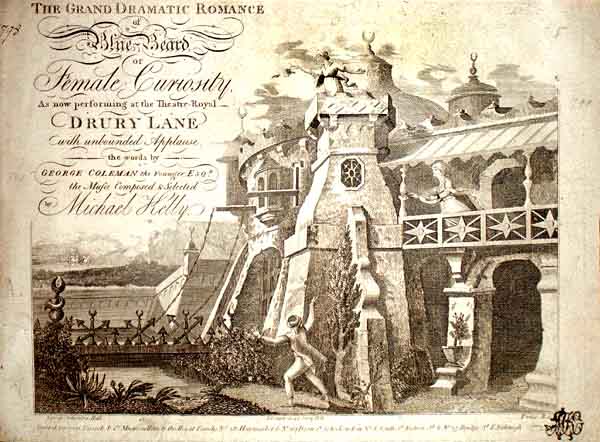
Bluebeard by George Colman the Younger


We often accuse Hollywood of being uncreative and unimaginative, constantly recycling popular films with sequels or remakes. It's a valid accusation but not a new one. It's been a trend with those who produce theatre and entertainment (books included) for centuries. Bluebeard provides a great example of this.

Bluebeard Tales From Around the World

When I started out making editorial decisions for Bluebeard Tales From Around the World I had no intention of including plays in the mix. Then I started reading them and reading about them and I knew I had to include some for they play an important role in Bluebeard's history. One could easily argue that the many, many productions of Bluebeard stories on the stage maintained its visibility and popularity in the 1800s. One of the most important and influential is Bluebeard by George Colman the Younger. From my introduction:

George Colman the Younger’s Blue-beard; or, Female Curiosity! A Dramatick Romance (1798) is often credited with popularizing the portrayal of Bluebeard as a Turk in future literature and illustrations. It didn’t create the trend but built upon the Turkish elements in a French production, Raoul Barbe Bleue (1789) by André Modeste Grétry and Paul Sedaine as well as the growing popularity of the Arabian Nights during that era. Colman’s play served as inspiration to many burlesques and operettas that followed in the 1800s, a few of which are included here.
There were many reasons for giving the production a Turkish setting--too many to discuss here or in my introduction--but it proved an unforgettable choice. The play was a smash hit and cemented the perception of Bluebeard as a Turk--turban, scimitar, and all. I'm oversimplifying the play's influences for the sake of brevity, but there were countless productions of Colman's play--musical actually--as well as remakes and rewrites and spoofs and references throughout the 19th century. Just as Disney influences what we see today about the fairy tales it has produced, Colman's Bluebeard influenced several generations and their perception of Bluebeard to the point where Perrault's popular tale was not as well known as this play by the less literate. There was clever writing and fun songs and a thrilling story.

Bluebeard: A Reader's Guide to the English Tradition

To read more about the work as well as what it influenced, I highly recommend Bluebeard: A Reader's Guide to the English Tradition by Casie E. Hermansson. (It's about much more than that, so I recommend it all around.) And of course, I included the full text of several of the plays in Bluebeard Tales From Around the World.

You can hear piano only renditions of the music from the play at Romantic-Era Songs and even over two centuries later one can understand how this musical caught the public's attention. Never underestimate the power of some catchy tunes. The score was by Michael Kelly.


And here is a very short excerpt from the play, a piece that is often collected in poetry anthologies that was extracted from the play:

Bluebeard
by George Colman the Younger
(1762–1836)

A FOND husband will, after a conjugal strife,
Kiss, forgive, weep, and fall on the neck of his wife.
But Abomelique’s wife other conduct may dread;
When he falls on her neck, ’tis to cut off her head.

How many there are, when a wife plays the fool,
Will argue the point with her calmly and cool;
The bashaw, who don’t relish debates of this sort,
Cuts the woman as well as the argument short.

But whatever her errors, ’tis mighty unfair
To cut off her head just as if ’twere all hair;
For this truth is maintained by philosophers still,
That the hair grows again but the head never will.

And among all the basest, sure he is most base
Who can view, then demolish, a woman’s sweet face!
Her smiles might the malice of devils disarm:
And the devil take him who would offer her harm!

Saturday, May 21, 2011

The Blue-Beard Chambers of the Heart by E. Spencer Miller


The Blue-Beard Chambers of the Heart
by E. Spencer Miller

MOULD upon the ceiling,
Mould upon the floor,
Windows barred and double barred,
Opening nevermore;

Spiders in the comers,
Spiders on the shelves,
Weaving frail and endless webs
Back upon themselves;

Weaving, ever weaving.
Weaving in the gloom,
Till the drooping drapery
Trails about the room.

Waken not the echo,
Nor the bat, that clings
In the curious crevices
Of the pannelings.

Waken not the echo.
It will haunt your ear
Wall and ceiling whispering
Words you would not hear.

Hist! the spectres gather,
Gather in the dark.
Where a breath has brushed away
Dust from off a mark;

Dust of weary winters,
Dust of solemn years,
Dust that deepens in the silence,
As the minute wears.

On the shelf and wainscot,
Window-bars and wall,
Covering infinite devices,
With its stealthy fall.

Hist! the spectres gather,
Break, and group again,
Wreathing, writhing, gibbering
Round that fearful stain;—

Blood upon the panels,
Blood upon the floor,
Blood that baffles wear and washing,
Red for evermore.

See,—they pause and listen,
Where the bat that clings,
Stirs within the crevices
Of the pannelings.

See,—they pause and listen,
Listen through the air;
How the eager life has struggled,
That was taken there;

See,—they pause and listen,
Listen in the gloom;
For a startled breath is sighing,
Sighing through the room.

Sighing in the corners,
Sighing on the floor,
Sighing through the window-bars,
That open nevermore.

Waken not those whispers;
They will pain your ears;
Waken not the dust that deepens
Through the solemn years—

Deepens in the silence,
Deepens in the dark;
Covering closer, as it gathers,
Many a fearful mark.

Hist! the spectres gather,
Break, and group again,
Wreathing, writhing, gibbering,
Round that fearful stain:—

Blood upon the panels,
Blood upon the floor,
Blood that baffles wear and washing,
Red forever more.

NOTES

Mr. E. Spencer Miller is a son of the late eminent theologian, the Reverend Samuel Miller, D.D., of Princeton, New Jersey, where he was born on the third day of September, 1817. When nineteen years of age he was graduated at Nassau Hall, in his native town, and having studied the law, and been admitted to the bar, in Philadelphia, chose that city for his residence, and has attained to a distinguished position there in his profession.
Mr. Miller has not hitherto been known to the public as a poet. The only book upon the title page of which he has placed his name, is a stout octavo called “A Treatise on the Law of Partition, by Writ, in Pennsylvania,” published in 1847; but while engaged in researches concerning this most unpoetical subject, in leisure hours his mind was teeming with those beautiful productions which were given to the world in 1849, in a modest anonymous volume entitled “Caprices.” Among these poems are some that evince an imagination of unusual sensibility and activity, and in all are displayed culture and wise reflection. No one of our poets has made a first appearance in a book of greater promise, and it will be justly regretted if devotion to the law or to any other pursuit prevents its accomplished author from keeping that promise to the lovers of literature.

Sources:

[Miller, E. Spencer]. Caprices. New York: Robert Carter & Brothers, 1849.

Griswold, Rufus Wilmot, editor. The Poets and Poetry of America. 16th edition. Philadelphia: Parry and McMillan, 1855.

And, yes, this is in Bluebeard Tales From Around the World.

Bluebeard Tales From Around the World

Saturday, May 7, 2011

The Story of Blue Beard: A Student's Ballad


Bluebeard Tales From Around the World

I included several poems in Bluebeard Tales From Around the World and one of the little surprises I found during my hunt was the following. Here it is excerpted from the book.

The Story of Blue Beard: A Student's Ballad

The following is a ballad written by an eighth grade student, a girl who participated in poetry classes conducted and written about by Nell Warden for an educational magazine, The American Schoolmaster, circa 1915. The piece was too charming to leave out of this anthology. It also demonstrates how Bluebeard was better known by children in the nineteenth century and beginning of the twentieth. Read the teacher’s notes at the end of the poem for more information.

NOW listen, friends, and I will tell
A tale of long ago,
Of Blue Beard with his bright blue hair,
And bright blue beard, you know.

A very wealthy man was he,
With chests of glittering gold,
And piles and piles of precious stones,
And piles of silver, cold.

But all his wealth did please him not,
For he did want a wife,
Said he, “Who’er will be my bride,
Shall labor not in life.

And she shall have my precious stones,
And all my silver, too;”
But none would wed this frightful man.
This man with beard of blue.

Now near Blue Beard a widow lived,
With two sweet daughters fair,
And Blue Beard wished to marry one,
For Fatima he did care.

“Oh come, sweet maiden, be my bride,
And you shall wealthy be,
Your mother and your sister bring,
And all may dwell with me.”

“I will,” she said, “I’ll marry you,
Tomorrow we will wed.”
For much she loved his wealth, you know;
And jewels for her head.

The next day was the wedding day,
A bright warm day was it,
Fatima, happy as could be,
On a jeweled chair did sit.

And they were married on that night,
A happy pair were they;
A feast was held to honor them,
And finish up the day.

But soon Blue Beard must go away,
A long, long trip to make;
But ere he went he said to her,
“My keys I will not take.

I’ll leave them all with you, my dear,
And you may try each door
But one, that this small key does fit,
I’ve ne’er told you of it before.”

And then Blue Beard took leave of her
And back to her friends she went;
But soon she quietly slipped away,—
To open that door she meant.

She turned the key and then the knob,
And peeped into the room.
She saw dead wives, their heads cut off!
And murder had been their doom!

She screamed and the key fell on the floor,
A bloody stain was left;
She locked the door and ran away,
And scoured with fingers deft.

The stain Blue Beard must not see there,
For she had promised true
To never use that one small key.
What would, what would she do!

She scoured and scrubbed; the stain came off,
But just to come again,
She used all kinds of scouring soaps;
Her scrubbing was in vain.

She went to the window and did look out,
And who did she happen to see?
Why, Blue Beard coming up the walk,
No other could it be!

She put the key in her pocket at once,
And went down to see Blue Beard.
Pretending not to know where ‘twas,
Though he’d find out she feared.

“Where are my keys?” he asked of her,
“Right here, my dear, are they.”
He looked at her. “They’re not all here;
Where’s the little one, I say?”

“Indeed, is not it there also?”
“You know it’s not,” he said,
“Give it to me at once, at once!
And now you’ll lose your head!”

And then she wept and begged for her life,
But all she said was vain;
“O, give to me one moment short,
In which to pray again.”

He granted this and nothing more,
Her life he would not spare;
His heart was still unmoved and hard,
And so she climbed the stair.

Her sister Anne went with her, too.
Fatima did not pray,
But only waited in suspense,
For her brothers to come that day.

“Sister Anne! Sister Anne! Do my brothers come?”
She asked in an anxious tone;
“I see them not,” said her sister Anne,
Fatima gave a groan.

“Do you see them yet?” she cried again,
“O sister, sister Anne.”
“I see nothing but a cloud of dust,”
Then to cry, Fatima began.

Then Blue Beard angry at his wife,
For staying there so long,—
“Will you come down, oh wretched maid?”
He cried in a voice so strong.

Fatima, frightened, answered back,
“O wait one moment more,”
“If you don’t come down, I’ll come up there,”
Did angry Blue Beard roar.

“Sister Anne, are my brothers coming?”
“O yes!” said her sister then,
And heavily tramped old Blue Beard, too,
A-coming to their den.

He opened the door and did walk in,
And then he drew his knife.
He grasped her beautiful golden hair,—
He meant to take her life.

When in there rushed her brothers three,
And grabbed old Blue Beard’s hand;
They slew him with his own sharp knife,
No longer did he stand.

Fatima, her brothers, and sister Anne,
Did every one rejoice.
“O, now we are rich,” they all did cry,
In a very happy voice.

NOTES

In this class the pupils studied the differences, in form and subject matter, between poetry and prose. The three great classes of poetic writing, narrative, lyric, and dramatic, were considered. The class decided that they would take as verse to imitate the simplest form of narrative poetry, the ballad. Some study of ballads resulted in the writing of the old folk stories—“Blue Beard” and “The Sleeping Beauty” in ballad form. Then followed a ballad written from a story of the early days of their own community. The last work of this class was the writing in prose of a simple story, having in it love, adventure, and a tragic ending, and turning this into a ballad. Not all of these ballads were good, and some of them were very, very funny; but each pupil gained much by the attempt at ballad making. “The Story of Blue Beard” was written by a girl in division B of the eighth grade.

Source:

Warden, Nell. “Versification in the Elementary School.” The American Schoolmaster: Published by the Michigan State Normal College. Vol. VIII, No. 6 (June 1915). pp. 241-253.

Saturday, April 30, 2011

The White Witch by James Weldon Johnson

The book of American Negro poetry

In my adolescence I enjoyed a short obsession with poetry and checked out book after book of it from my middle school library. I would type up my favorite poems and I remember loving James Weldon Johnson and Langston Hughes in particular. My middle school library was filled with the works of African American poets--it must have been a soft spot and quest of my adored African American librarian at the school. "Go Down Death" by James Weldon Johnson resonated then and it still one of the few poems I can quote parts to myself. (I am a horrible, horrible memorizer so that is a feat.) 

Anyway, this poem is Johnson's own invention and has many possible interpretations When rereading it this month, I was also reminded of The Snow Queen, so I decided to share it here. That's the beauty of poetry. We bring our own experience to it which gives it other meanings the poet perhaps never intended. Of course, this one has many layers considering Johnson's heritage, but he creates a parable type story where it can be as innocuous or as subversive as one would like.

The White Witch
by James Weldon Johnson

O brothers mine, take care! Take care!
The great white witch rides out to-night.
Trust not your prowess nor your strength,
Your only safety lies in flight;
For in her glance there is a snare,
And in her smile there is a blight.

The great white witch you have not seen?
Then, younger brothers mine, forsooth,
Like nursery children you have looked
For ancient hag and snaggle-tooth;
But no, not so; the witch appears
In all the glowing charms of youth.

Her lips are like carnations, red,
Her face like new-born lilies, fair,
Her eyes like ocean waters, blue,
She moves with subtle grace and air,
And all about her head there floats
The golden glory of her hair.

But though she always thus appears
In form of youth and mood of mirth,
Unnumbered centuries are hers,
The infant planets saw her birth;
The child of throbbing Life is she,
Twin sister to the greedy earth.

And back behind those smiling lips,
And down within those laughing eyes,
And underneath the soft caress
Of hand and voice and purring sighs,
The shadow of the panther lurks,
The spirit of the vampire lies.

For I have seen the great white witch,
And she has led me to her lair,
And I have kissed her red, red lips
And cruel face so white and fair;
Around me she has twined her arms,
And bound me with her yellow hair.

I felt those red lips burn and sear
My body like a living coal;
Obeyed the power of those eyes
As the needle trembles to the pole;
And did not care although I felt
The strength go ebbing from my soul.

Oh! she has seen your strong young limbs,
And heard your laughter loud and gay,
And in your voices she has caught
The echo of a far-off day,
When man was closer to the earth;
And she has marked you for her prey.

She feels the old Antaean strength
In you, the great dynamic beat
Of primal passions, and she sees
In you the last besieged retreat
Of love relentless, lusty, fierce,
Love pain-ecstatic, cruel-sweet.

O, brothers mine, take care! Take care!
The great white witch rides out to-night.
O, younger brothers mine, beware!
Look not upon her beauty bright;
For in her glance there is a snare,
And in her smile there is a blight.

From The Book of American Negro Poetry, edited by James Weldon Johnson, published in 1922. (Found on Poets.org and elsewhere on the web.) This one is out of copyright.
Related Posts Plugin for WordPress, Blogger...
hostgator discount